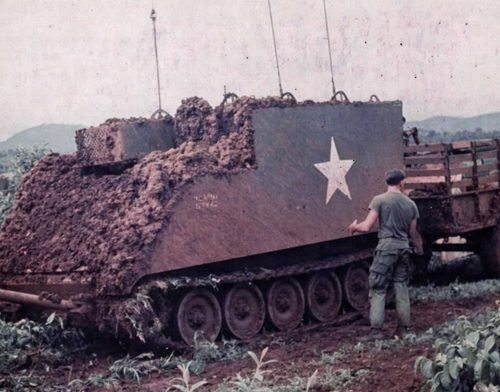
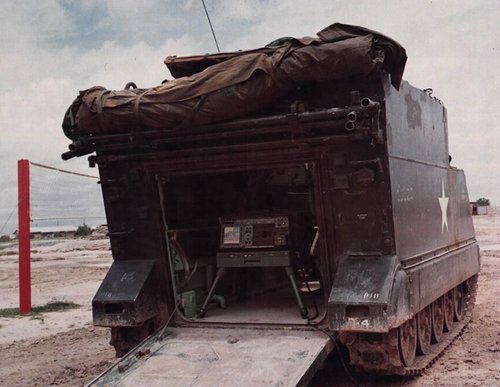
The fire direction center was central to the firing battery: in Vietnam a small, well-bunkered position with the people and equipment to take fire requests from the forward observers and turn them into data the guns could use 8. A battery’s fire direction center normally backed up the battalion’s and worked on its own when the battery was too far from its parent unit 8. In the mixed 8-inch and 175-mm batteries in Vietnam it sat at the centre of the battery position, with the 175-mm guns farthest from it 8; the 1976 field manual for the cannon battery counts it, with the firing battery headquarters and the howitzer sections, as part of the firing battery 5.
The assistant executive officer normally supervised it as the fire direction officer 5, answerable among other things for accurate and timely firing data 5. With him worked a chief computer and computers — Army specialties 13E40 and 13E20 24 — and, in the 1981 gunnery manual’s list, chart operators and a radio operator 30. In 1970 the 6th Battalion, 27th Artillery, an 8-inch and 175-mm battalion, was authorized six fire direction men in each firing battery and reported that this was not enough to run two fire direction centers around the clock when a battery was split 9. The Marine Corps’ counterpart, in a 1993 Defense Department index, was the field artillery fire control man, specialty 0844 14.
The FADAC computer reached Vietnam in 1966–67 and was the main means of computing fire data by 1969 6, with hand computation kept as a backup 6; in the 54th Field Artillery Group the battalion and every firing battery had one FADAC and two generators for it 25. The battery computer system followed, and by 1979 the TACFIRE system was described as linking it with the other fire-control equipment 6.
Which vehicle carried an 8-inch battery’s fire direction center is the one thing no document read says in words; the Army’s equipment tables come closest. In 1971 each 8-inch self-propelled battery of an armored or mechanized division was allotted one light tracked command post carrier beside its four howitzers 2, and the same manual names that line item the M577 2. The tables of 1976–78 give each 8-inch battery the same single carrier, with four tracked cargo carriers 35; in the infantry division’s mixed 155-mm and 8-inch battalion the 8-inch battery was allotted the battalion’s only one, and the towed 155-mm batteries none 35. The Army’s 1984 gunnery manual gives the approved layout of a battery fire direction center inside the M577A1, fitted with FADAC or with the battery computer system 29.
In Vietnam, a report of May 1967 puts a 175-mm battalion’s fire direction charts in the M-577’s tent extension 36, and another of August 1967 has one moving with a 175-mm battery 37, and the 1st Battalion, 83rd Artillery’s veterans’ website says an M113 personnel carrier served as the fire direction center when a firing battery went out on artillery raids 38. Read together, these point to the M577 — this page’s reading, not a statement any document makes: the tables give the carrier to the battery, not by name to its fire direction center 2.
Fire direction centers and their vehicles as the archive captions describe them; each caption names the unit and, where the archive or the unit’s record gives it, the weapon. Tap a photograph to enlarge it.