Page 3 · Combat History · Pilot Awards · Korea 1950–53
First jet kills, a seven-MiG fight, and the men who flew it
The Panther opened the Navy's jet war on 3 July 1950, scored the first Navy jet-versus-jet kill that November, and spent the rest of the war cutting rails and bridges under the guns. Here are the actions, the citations by name, and three famous aviators — with each claim traced to the record.
Setting the stage · 25 June 1950 – 27 July 1953
The war the Panther flew in
At dawn on 25 June 1950 the North Korean People's Army — 89,000 men with about 200 Soviet-built T-34 tanks — crossed the 38th Parallel into South Korea[40]. The United States went to war under a United Nations mandate with a Navy shrunk by five years of budget cuts: of the twenty-four Essex-class carriers built in the Second World War only five were still operational, and the Pacific Fleet had three of them, no battleships and five heavy cruisers[40]. One carrier, USS Valley Forge (CV-45), was in the western Pacific with Task Force 77 when the war began; two months into her cruise, her two Panther squadrons, VF-51 and VF-52, had to work out the rules of jet operations from a carrier deck in combat[42, 40].
The enemy in the air was small at first — an estimated 54 aircraft in the North Korean air force before the war, 33 Yak fighters and 21 Il attack bombers — which is why the Panthers' first kills on 3 July were Yak-9s over Pyongyang[46, 1]. That changed in November 1950. China entered the war — the Chinese Ninth and Thirteenth Army Groups struck on 27 November — and from 1 November 1950 Soviet-flown MiG-15s of what became the 64th Fighter Aviation Corps began patrolling from Antung, across the Yalu River in Manchuria, in Chinese markings, with pilots in Chinese uniforms who were told not to speak Russian on the radio and not to fly over the sea[44, 41]. The MiG outperformed the Panther, so from the end of 1950 the Air Force's F-86 Sabres took over most of the bomber-escort work; the Navy's jets turned to strike, close air support and flak suppression, and two F9F-2Bs of VF-191 flew the Navy's first jet bombing mission, against a railroad bridge near Songjin, on 2 April 1951[42, 41].
The enemy on the ground is what this page's loss figures are about. After the front stabilised in mid-1951 the carrier war became interdiction — rails, bridges, tunnels, trucks — and the Communists answered with guns. In mid-1951 China was asked for twelve anti-aircraft artillery regiments to defend the Yalu bridges alone; by 1952 there were more than eighty AAA regiments in North Korea, and about two-thirds of the North's automatic weapons were sited against exactly the interdiction flights the Panthers were flying[42]. The war ended where it began: the armistice was signed at Panmunjom on 27 July 1953, two days after Task Force 77 set its one-day record of 538 offensive and 62 defensive sorties[41].
The scale of the naval air war is easy to underestimate because "at no time were more than four large carriers in action at the same time"[41]. In three years Navy and Marine aircraft flew 276,000 combat sorties, dropped 177,000 tons of bombs and fired 272,000 rockets — within 7,000 sorties of their entire Second World War total in all theatres, and 74,000 tons more bombs[41]. The Panther flew about 78,000 of those sorties, more than any other naval jet[39].
Who was shooting
North Korea, 1950 — a 54-aircraft air force of Yak fighters and Il-10 attack bombers; gone as a factor within weeks[46].
Soviet Union, from 1 Nov 1950 — the 64th Fighter Aviation Corps, MiG-15s flying from Manchuria; 64,000 sorties, a claimed 1,097 UN aircraft, and by its own records 335 aircraft and 120 pilots lost[44]. The 18 November 1952 fight on this page was against these pilots[7].
China and North Korea on the ground — 37 mm automatic guns along the supply routes, 12.7 mm machine guns, and 57 mm, 85 mm and 100 mm heavy guns around the bridges, power plants and ports; more than 80 AAA regiments by 1952[42, 43]. These accounted for 559 of the 564 Navy and Marine aircraft lost to the enemy[25].

3 July 1950
Into combat: the Navy's first jet strike and first jet kills
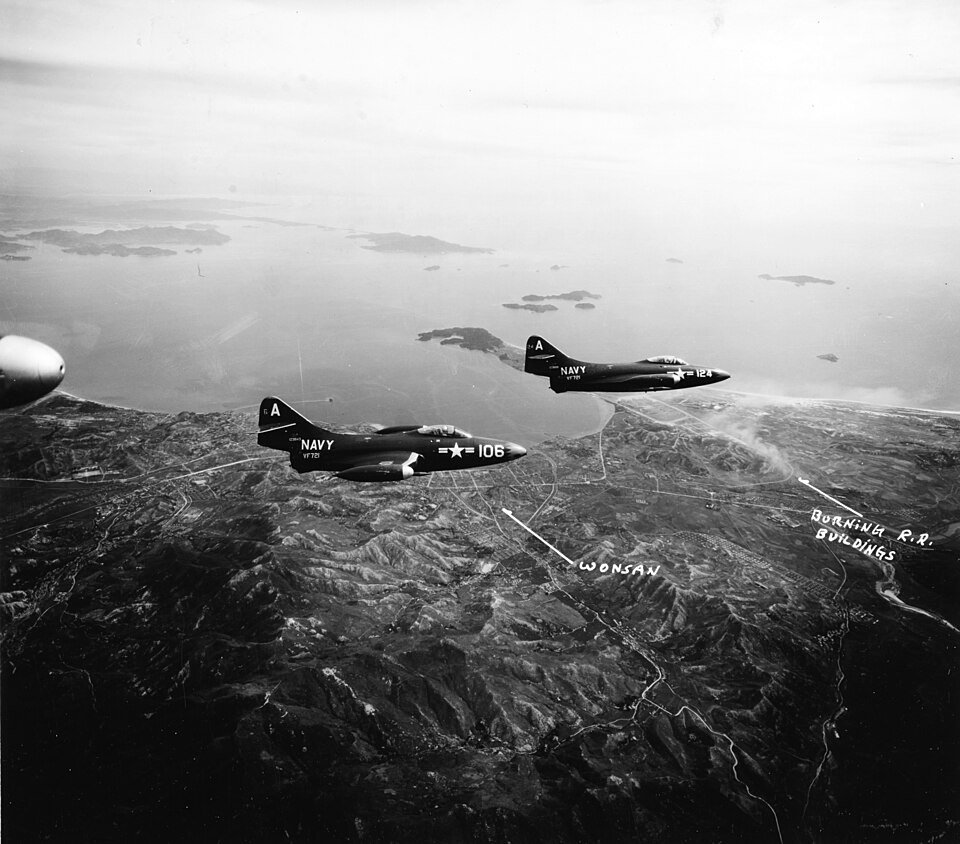
Eight days after the North Korean invasion, USS Valley Forge (CV-45) launched the Navy's first jet combat mission: eight F9F-3 Panthers of VF-51 leading the strike on the airfield at Pyongyang on 3 July 1950[2, 3]. The Panthers had four 20 mm cannon and nothing else — "not yet fitted with pylons to carry ordnance" — and no lead-computing gunsight; Carrier Air Group commander Harvey Lanham led them up to 16,000 feet[3].
As Lt(jg) Leonard H. Plog, flying F9F-3 BuNo 123071, strafed the field, a Yak-9 took off. Naval Aviation News told it plainly: "Lt. (jg) Plog blew off its wing with a short burst, scoring the Navy's first aerial victory in Korea"[1]. A second Yak fell to Ens. E. W. Brown of the same squadron[1, 2, 3]. These were the first air-to-air victories by U.S. Navy jets. Plog received the Air Medal, presented by Rear Adm. John Hoskins, Commander Carrier Division 3[1]; no award for Brown was found. (Sources even disagree on Brown's first name — "Eldon" in Dorr, "Eugene" in Naval Aviation News — so this page prints his initials.)
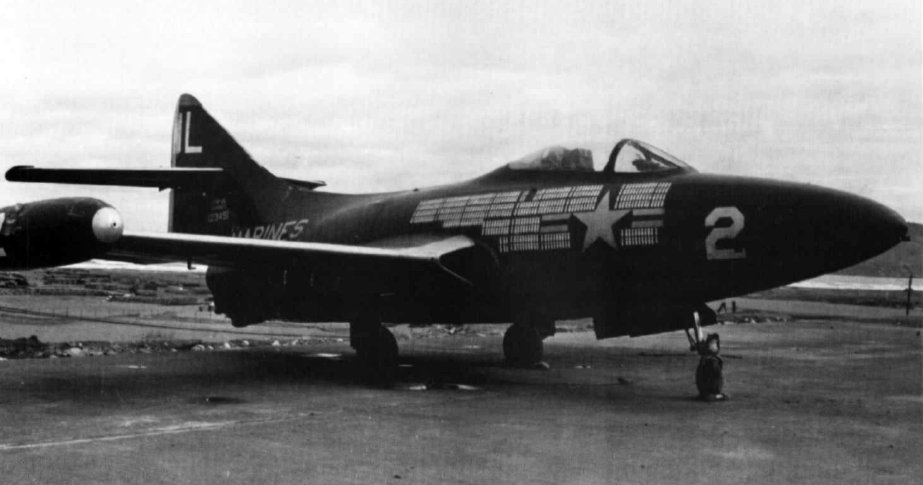
The Marines' jet war began five months later. VMF-311 reached Yonpo on 10 December 1950 and flew its first combat missions that afternoon — the first land-based Marine jet squadron in combat — was pushed back to Pusan three days later by the Chinese offensive, and remained the only Marine jet squadron in Korea until February 1952[4, 23]. By January 1951 its Panthers were briefly grounded by engine problems[23].




9 November 1950
The first Navy jet-versus-jet kill
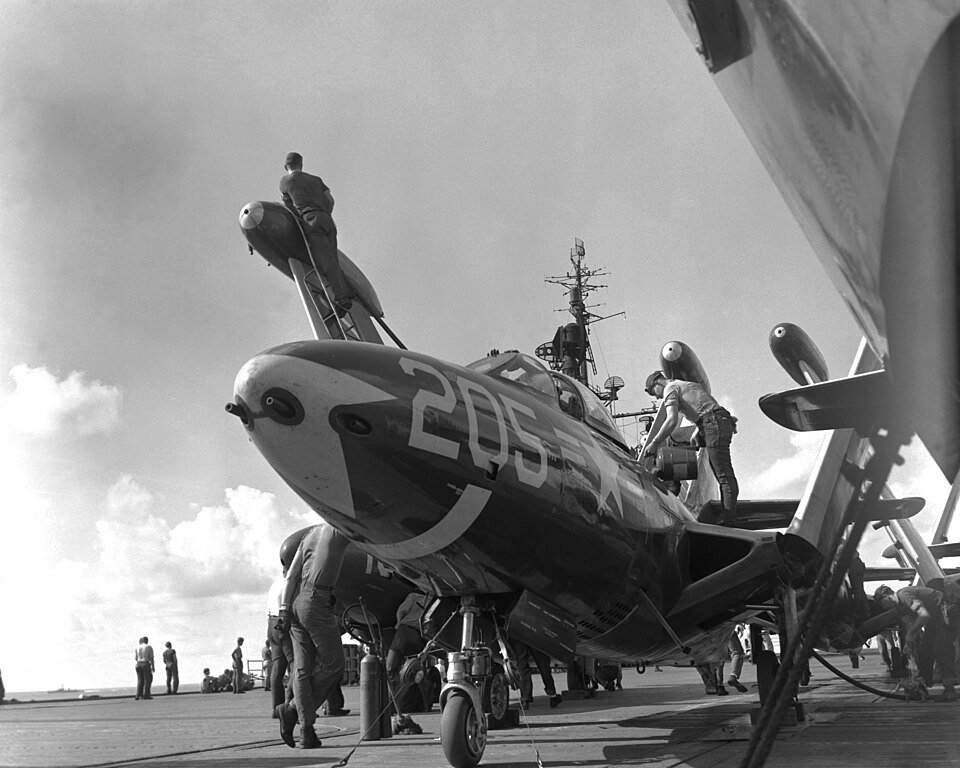
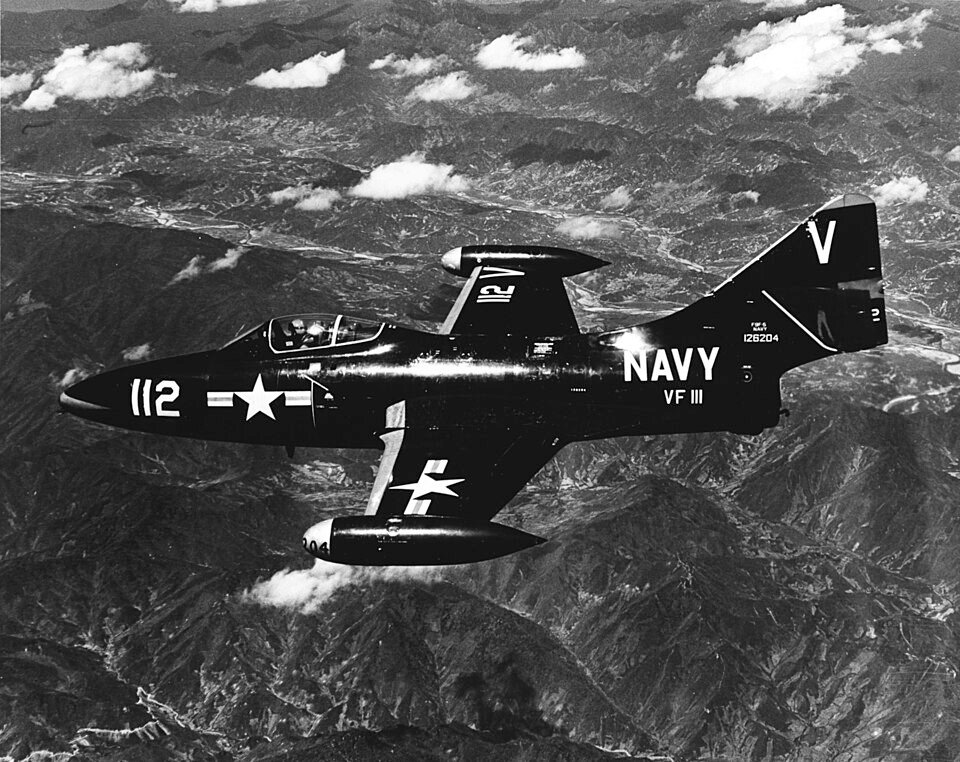
On 9 November 1950 Lt Cdr William T. Amen, commanding VF-111 "Sundowners" from USS Philippine Sea (CV-47), was leading F9F-2B Panthers as high cover for AD Skyraider strikes on the Yalu River bridges at Sinuiju when at least five MiG-15s came across from Antung. Amen got behind a diving MiG and fired his four 20 mm cannon; his wingman watched it "crash into a wooded slope and burn"[5, 4]. The MiG pilot was Capt. Mikhail Fedorovich Grachev of the Soviet 139th Guards Fighter Aviation Regiment, who was killed[4, 5].
The Naval History and Heritage Command calls it "the first U.S. Navy jet-versus-jet kill, and the first Navy kill of a MiG-15", and adds that "some accounts state that it was the first kill by anyone of a MiG-15"[4]. The Air Force credits 1st Lt Russell J. Brown's F-80C with a MiG the day before, 8 November; Soviet records, however, show his opponent, Sr Lt Kharitonov, dived away and survived[6]. Amen's is therefore the first jet-versus-jet kill confirmed by both sides' records, while the USAF still credits Brown's claim — this page presents it as disputed.
Nine days later the Panthers did it twice more: on 18 November 1950 Lt Cdr William E. Lamb and Lt Robert E. Parker of VF-52 (Valley Forge) shared a MiG-15, and Ens. Frederick C. Weber of VF-31 (Leyte) shot down another[4]. Amen was awarded the Distinguished Flying Cross for 30 combat missions on Philippine Sea's first deployment; no Silver Star for the MiG was found, nor awards for Lamb, Parker or Weber[4, 5]. Even his aircraft is uncertain — BuNo 127184 in one account, 127094 borrowed from VF-112 in another.
18 November 1952
Royce Williams: thirty-five minutes alone against the Soviet Navy
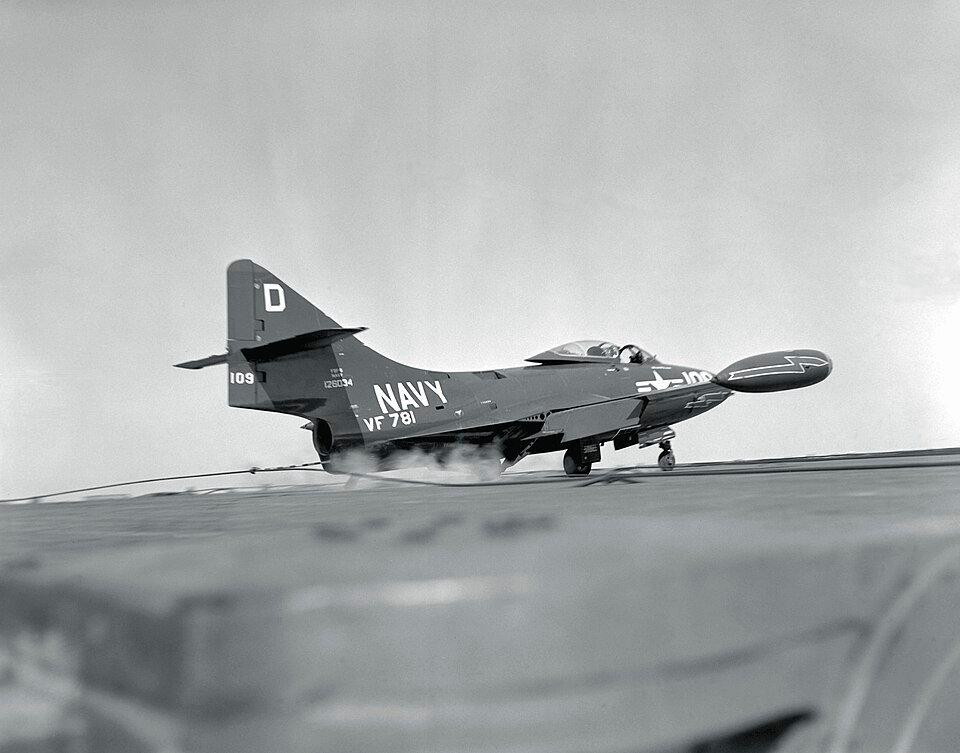
Task Force 77 was striking Hoeryong, close to the Soviet border and about 80 nautical miles from Vladivostok, on 18 November 1952, when seven MiG-15s under Soviet ground control came south from Unashi airfield toward the carriers. A four-plane division of F9F-5 Panthers from VF-781 "Pacemakers" — a Naval Reserve squadron from Los Alamitos embarked in USS Oriskany (CVA-34) — went up to meet them: Lt Claire Elwood leading, Lt(jg) John Middleton, Lt(jg) Dave Rowlands and, as section leader, Lt E. Royce Williams[7]. Elwood turned back with a fuel-pump warning, Middleton followed a MiG down, and Williams found himself alone against six[7].
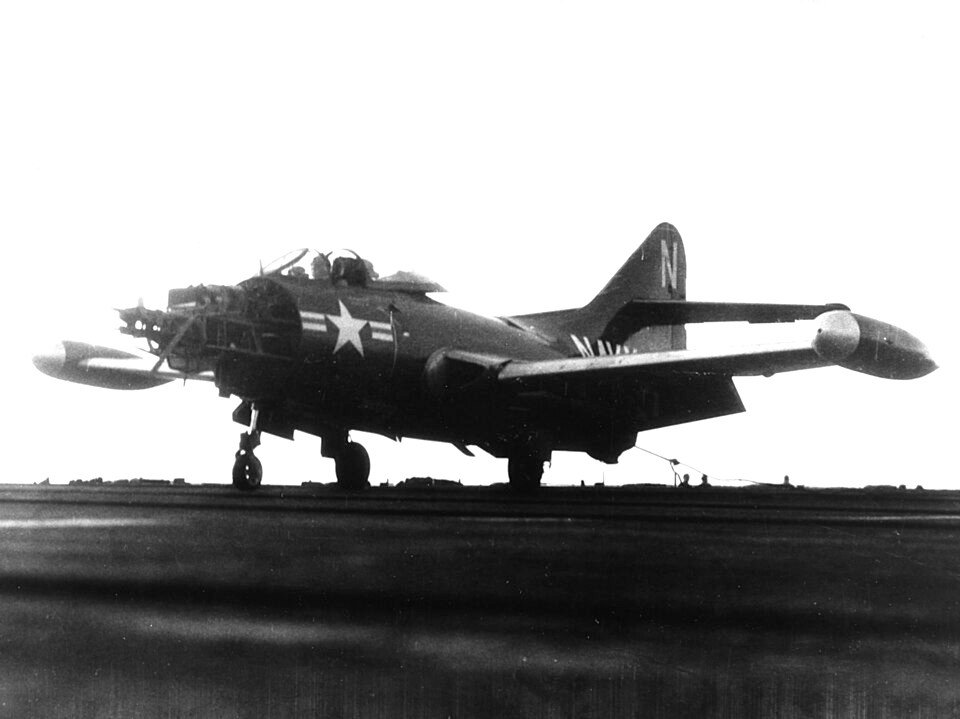
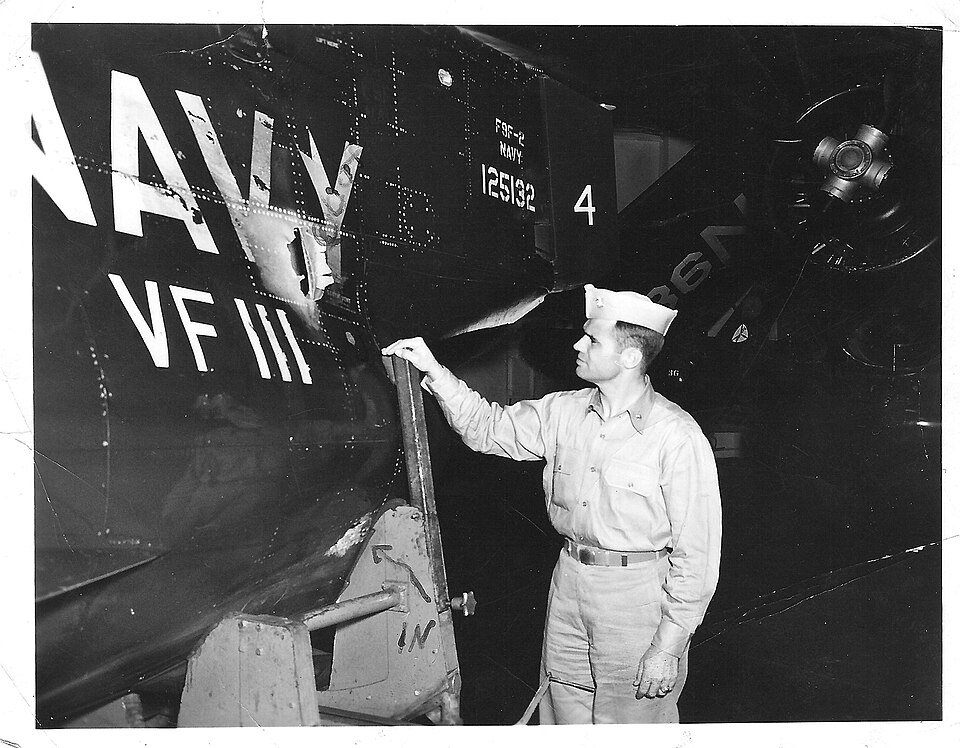
He fired all 760 rounds. A 37 mm shell blew "a big hole in his wing root" and the jet took more than 250 shrapnel holes — 263 by one count; with hydraulics gone he landed back aboard at about 170 knots against a normal 105 and caught the 3-wire[7, 12]. "They had me cold on maneuverability," he said. "The only thing I could do was out-turn them"[11]. NHHC's research, contrary to the popular story, found the aircraft "was not dumped over the side … but was repaired and returned to service"[7].
The Navy credited Williams at the time with one MiG destroyed and one damaged, Middleton with one destroyed and Rowlands with one damaged. Russian records opened decades later show at least four, and possibly five, Soviet pilots killed, three in the fight and one trying to bring a damaged jet home[7]. Because NSA radio intelligence had proved the pilots were Soviet, flying under Soviet control, the engagement stayed classified for decades[7, 12].
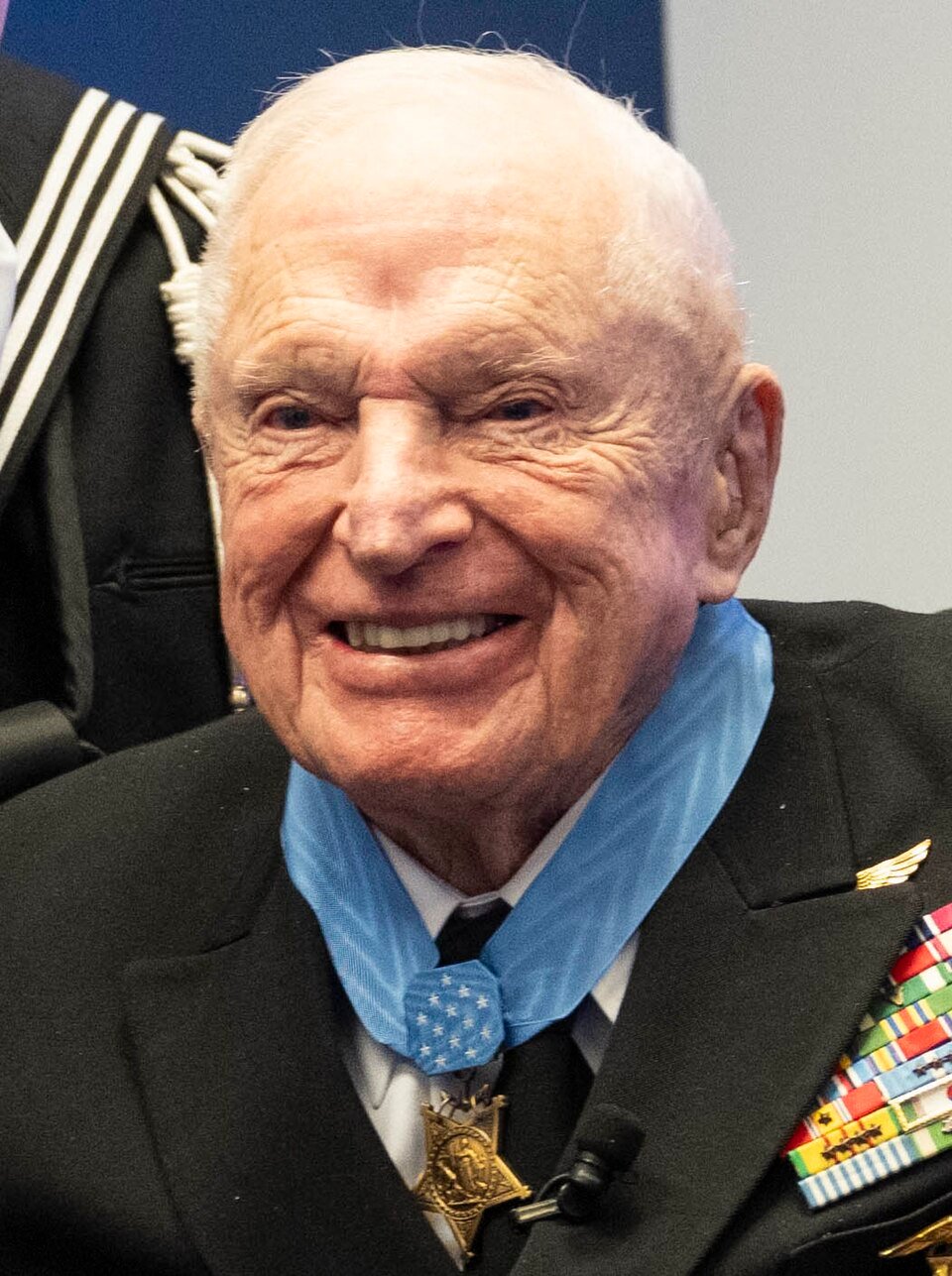
The recognition came in three steps. Silver Star, 7 May 1953, on a citation NHHC calls "historically inaccurate" because it could not say who the enemy was[8, 7]. Navy Cross, presented by Secretary of the Navy Carlos Del Toro at the San Diego Air & Space Museum on 20 January 2023[8]. And, after the FY2026 defense bill removed the time limit, the Medal of Honor, presented at the State of the Union on 24 February 2026, when Williams was 100 years old[11, 10, 9]. The citation credits his division with "the destruction of three enemy MiG-15s and severe damage to a fourth" and Williams himself with "two firing passes on one MiG, which then spiraled into the sea"[9]. Middleton received the Silver Star and Rowlands the Distinguished Flying Cross for the same fight[15, 16].



The Panther's real war
Bridges, rails, flak and the men on the ground
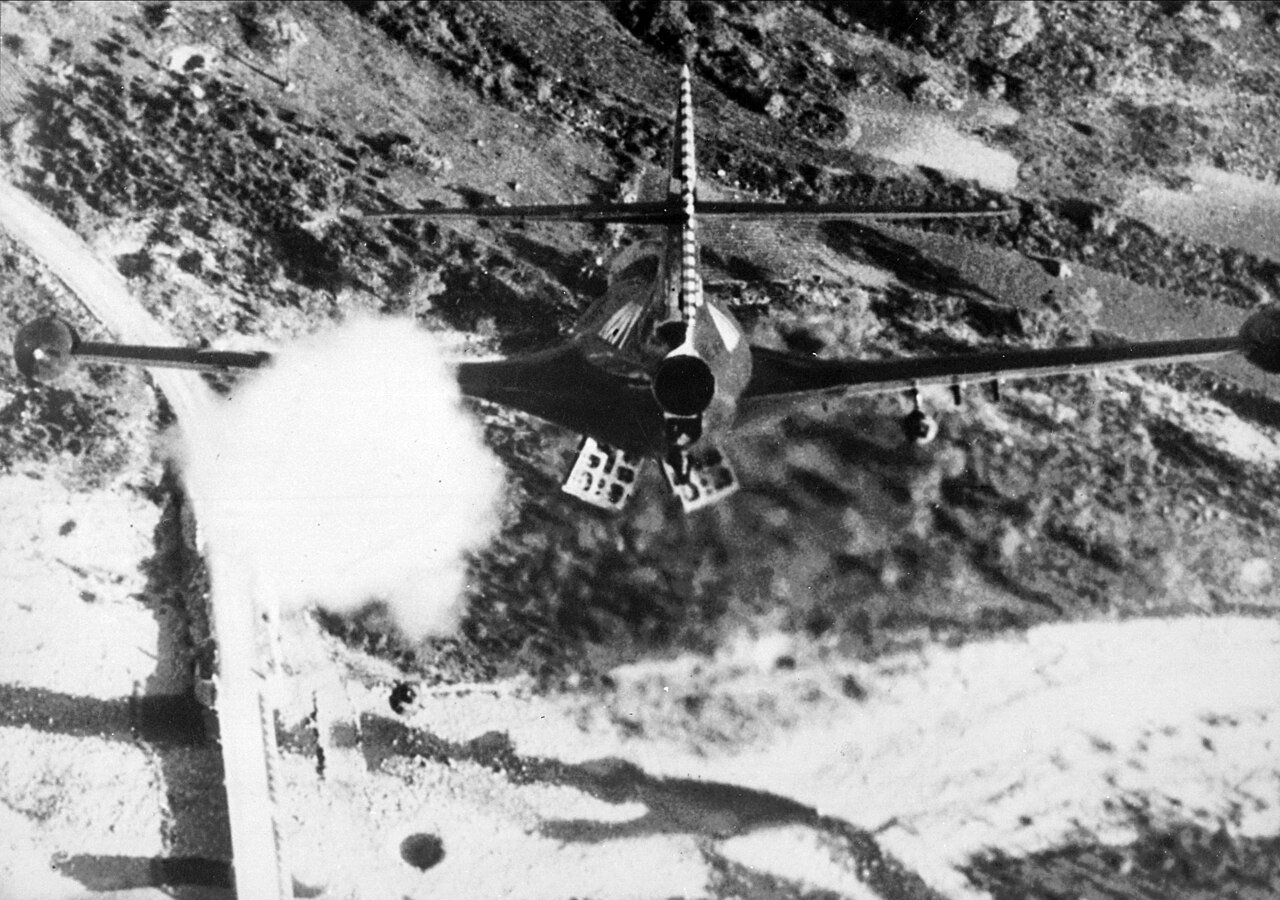
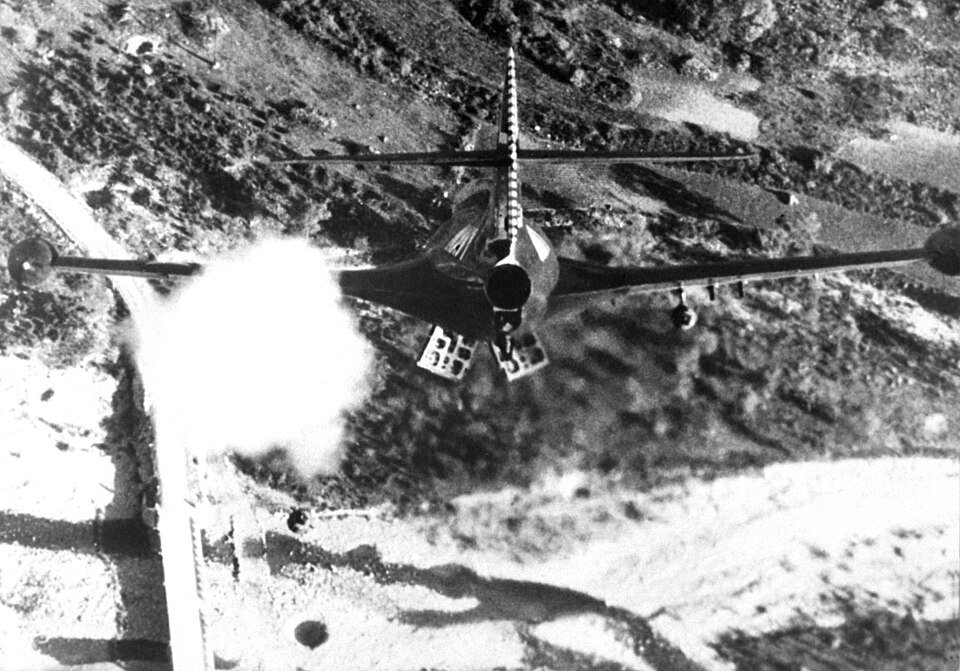
MiG fights were the exception. Day after day the Panther squadrons flew high cover and flak suppression for the Skyraiders and Corsairs, then went down themselves with bombs and rockets. In November 1950 they covered the Yalu bridge strikes at Sinuiju that helped "destroy six of the seventeen bridges linking North Korea to Manchuria"[4, 25]; they flew over the Marines' fighting withdrawal from Chosin[4]; and from late 1951 they cut rails — naval aircraft made "some 2,782 track cuts" between 28 December 1951 and 1 February 1952 alone[25].
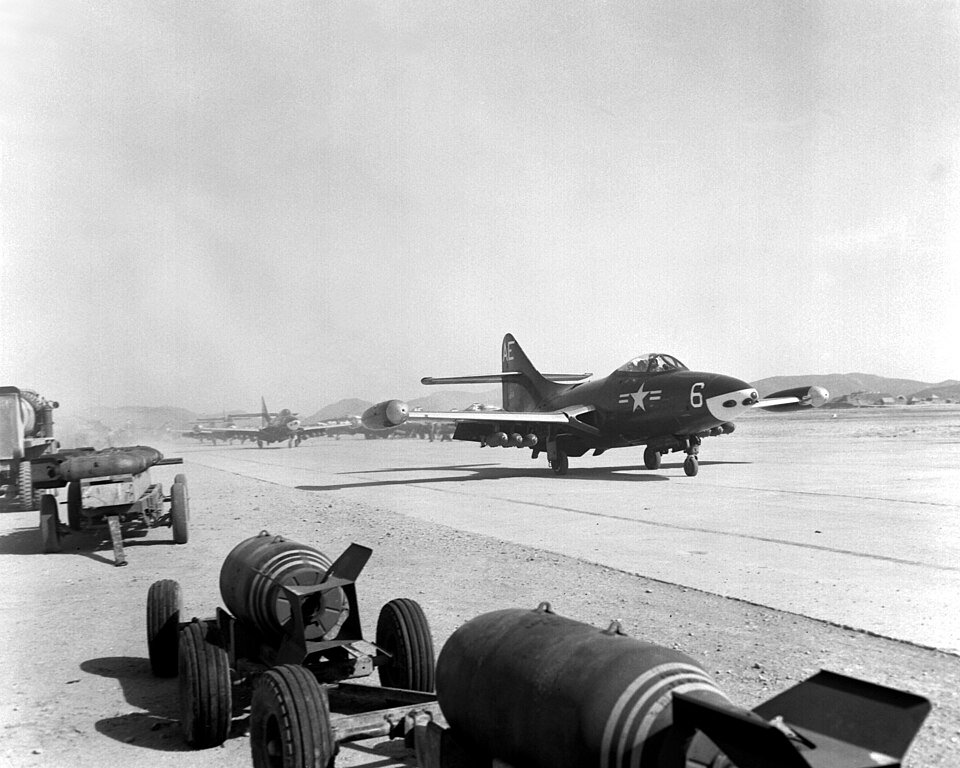
Two set-pieces show the scale. On 23 June 1952 four carriers — Boxer, Princeton, Philippine Sea and Bon Homme Richard — sent 35 Skyraiders and 35 Panthers, 24 of them carrying two 250-lb bombs for flak suppression, against the Sui-ho hydroelectric plant, under 84 Air Force F-86s; only five Navy aircraft took hits[26]. And from 1952 Vice Adm. J. J. "Jocko" Clark's "Cherokee" strikes — pre-briefed attacks on supply dumps just behind the front — ran at a pace of 522 missions in the 2–25 November 1952 period alone[26]. VMF-311 "pioneered strip-alert tactics" for Marine close air support and took part in Sui-ho; its Capt. William L. Armagost dropped the last Marine bombs of the war[24]. The Marines had to rework their close-air-support doctrine around a jet's "high speed and reduced range and loitering capabilities"[23].
The cost was overwhelmingly flak. Across 37 months Navy and Marine aircraft of all types lost 559 aircraft to anti-aircraft fire and five in air combat[25]; Polmar states that "no Panthers were lost in air-to-air combat", while Wikipedia, citing Davies, says two[2, 39]. The section What was lost below breaks those figures down — by cause, by service and, where the record allows, by type. Photo-reconnaissance was Panther work too: VC-61's F9F-2P detachments replaced the squadron's Corsair photo planes in mid-1951, and it was F9F photo aircraft that found the defended valley targets behind The Bridges at Toko-Ri — though the strike James Michener saw, on 8 February 1952 from Valley Forge, was flown by Skyraiders and Corsairs, not Panthers[28, 27].








What was lost — and to what
559 to the guns, five to enemy aircraft: the figures behind the tile
The "559 : 5" at the top of this page is Gerald E. Wheeler's count, published in Proceedings four years after the armistice: "In 37 months of fighting the Navy and Marine Corps lost 559 aircraft to enemy anti-aircraft fire and only five planes in aerial combat"[25]. It counts every type the Navy and Marine Corps flew — Corsairs, Skyraiders, Panthers, Banshees, Neptunes, helicopters — and only losses to the enemy: 564 aircraft in all, of which 99 per cent fell to guns on the ground and one per cent to MiGs and Yaks. It does not count aircraft lost to accidents, weather, fuel or the carrier deck — which, in the two months the Navy's own chronology itemises, outnumbered the enemy's work: in November 1950 naval aviation lost six aircraft to enemy action and 27 operationally, and in December sixteen to the enemy and 32 to accidents[41]. A whole-war total of operational losses was searched for in the NHHC chronologies and not found; the monthly figures above are what the Navy's own history prints.
Why the guns. After the front stabilised in 1951 the carriers' job was interdiction, and interdiction means flying low and predictably along the same rails and bridges the enemy knew he had to defend. The supply routes were guarded mainly by 37 mm automatic weapons — "a major threat to F9F interdiction flights" — with 12.7 mm machine guns for the low passes and 57 mm, 85 mm and 100 mm guns, occasionally 82 mm rockets, around the bridges, ports and power plants; by 1952 more than eighty AAA regiments stood in North Korea, and two-thirds of its automatic weapons were pointed at interdiction flights[42, 43]. The most dangerous Panther sorties were flak suppression itself: attacking the guns "after baiting them into firing and revealing their positions"[42]. Peter Mersky, reviewing Peter Davies's study for Naval Aviation News, calls ground fire "the most harrowing and perhaps effective" threat the Panther pilots faced[43].
What the Panther's share was. Davies's figures are the only type-by-type ones found: between July 1951 and the end of hostilities the Navy lost 384 aircraft to anti-aircraft fire, of which 57 were F9F Panthers and 193 were F4U Corsairs, which "still took the hardest hits"; the Panther's own toll rose as the guns multiplied — 44 Panthers were lost to flak in the twelve months from July 1952[42]. Jets "survived AAA damage better than the F4U", but the piston-engined Corsair was the better aircraft for digging guns out of valleys[42]. Against that, Panthers claimed seven MiG-15s for two of their own lost to MiGs by Davies's count; Polmar says none were lost in air-to-air combat[39, 2]. The figures before July 1951, and the Marines' Panther losses at K-3, were not found as separate numbers.
Against the other services and the enemy. The United Nations air forces lost 1,986 aircraft in the war, 1,466 of them Air Force, whose casualties were 1,841 including 1,180 dead[45]. The Soviet 64th Fighter Aviation Corps, whose MiGs the Panthers met, flew 64,000 sorties and claimed 1,097 UN aircraft while admitting 335 aircraft and 120 pilots of its own lost[44]. The men. How many Navy and Marine aviators died behind the 564 aircraft was not found as a single figure in the sources reached; the Defense POW/MIA Accounting Agency's Korean War Air Loss Database lists the airmen still unaccounted for, name by name and aircraft by aircraft, and is linked in the sources[47]. One rescue system did bring the numbers down: Wonsan harbour became "a sanctuary for aircraft damaged by enemy fire that ditched in the harbor", where helicopters lifted the crews out[41].
| Loss | Number | Span · source |
|---|---|---|
| Navy & Marine aircraft, all types, lost to anti-aircraft fire | 559 | 37 months · Wheeler[25] |
| … lost in air combat | 5 | 37 months · Wheeler[25] |
| Navy aircraft lost to AAA | 384 | Jul 1951 – Jul 1953 · Davies[42] |
| … of which F9F Panthers | 57 | Jul 1951 – Jul 1953 · Davies[42] |
| … of which F4U Corsairs | 193 | Jul 1951 – Jul 1953 · Davies[42] |
| Panthers lost to flak | 44 | Jul 1952 – Jul 1953 · Davies[42] |
| Panthers lost to MiG-15s | 2 (Polmar: 0) | whole war · Davies via Wikipedia; Polmar[39, 2] |
| Naval aviation losses, enemy / operational | 6 / 27; 16 / 32 | Nov 1950; Dec 1950 · NHHC[41] |
| UN aircraft lost, all services | 1,986 (USAF 1,466) | whole war · USAF history[45] |
| Soviet 64th IAK, own losses | 335 aircraft, 120 pilots | Nov 1950 – Jul 1953 · Seidov via Wikipedia[44] |
| Panthers lost to flak before Jul 1951; Marine Panther losses; aviators killed | not found | — |

Awards to Panther pilots, by name
Citations
Each entry gives the award, the squadron and ship or base, the date of the action, the awarding authority and — wherever the government has published it — the citation itself, quoted in full. Where no wording has been published the entry says so rather than paraphrasing one. "Confirmed" means two independent sources; "single-source" means one. Searched for and not found: a Silver Star or Navy Cross for Amen; awards for Brown, Lamb, Parker or Weber; any Korean War Navy Cross to a Marine Panther pilot.
Medal of Honor (24 Feb 2026) · Navy Cross (20 Jan 2023) · Silver Star (7 May 1953)
Led a division of F9F-5 Panthers against seven Soviet MiG-15s protecting Task Force 77 and landed a "nearly uncontrollable aircraft" aboard. The same action was recognised three times over 73 years; only the Medal of Honor wording has been published. Also two DFCs, Legion of Merit with "V", Bronze Star and 11 Air Medals in a career that ended as CO of Carrier Air Wing 11 and retirement as a Captain in 1980[9, 8, 12].
Medal of Honor citationFor conspicuous gallantry and intrepidity at the risk of his life above and beyond the call of duty on 18 November 1952 while leading a division of three jet fighters attached to Fighter Squadron SEVEN HUNDRED EIGHTY-ONE (VF-781) and embarked on the USS ORISKANY. While flying a combat patrol mission over the northeastern coastal waters of enemy-held North Korea, Lieutenant Williams demonstrated extraordinary heroism by intercepting a superior force of attacking enemy MiG-15 fighters in order to protect the ships of Task Force 77. After thwarting the enemy's initial attack, he maneuvered his aircraft to make two firing passes on one MiG, which then spiraled into the sea. He inflicted heavy damage to a second MiG-15, which started smoking badly and retired from the fight.
When his own aircraft was severely damaged by a direct hit from one of the remaining enemy MiG-15s, Lieutenant Williams evaded further enemy attack while continuing to direct the dogfight. He eventually found cover in a cloud bank, broke off the engagement, and miraculously landed his nearly uncontrollable aircraft on the USS ORISKANY. His exceptional airmanship, coupled with his complete disregard for his own personal safety, resulted in the destruction of three enemy MiG-15s and severe damage to a fourth, and undoubtedly saved the lives of hundreds of Task Force 77 sailors. By his undaunted courage, bold initiative, and total devotion to duty, Lieutenant Williams reflected great credit upon himself and upheld the highest traditions of the United States Naval Service.
Navy Cross — approved by Secretary of the Navy Carlos Del Toro in December 2022 as an upgrade of the Silver Star ("I authorize the Navy Cross be awarded for his valorous actions committed from personal bravery and self-sacrifice to country") and presented at the San Diego Air & Space Museum on 20 January 2023. No citation text has been published[20, 8].
Silver Star — Commander Seventh Fleet Serial 835, 7 May 1953, the same serial as Middleton’s. Its wording, written while the fight was classified and unable to say who the enemy was, is the one NHHC calls "historically inaccurate"; the text has not been published[21, 20, 7].
Navy Cross (posthumous) · DFC · Air Medal with two Gold Stars
Former Blue Angels leader whose team formed the nucleus of VF-191. Killed on the mission. The citation does not name the aircraft; VF-191 flew F9F-2 Panthers. His DFC and Air Medal citations were not found[13, 14, 36].
Navy Cross citationThe President of the United States of America takes pride in presenting the Navy Cross (Posthumously) to Lieutenant Commander John Joseph Magda (NSN: 0-98678), United States Navy, for extraordinary heroism in connection with military operations against an armed enemy of the United Nations while serving as a Pilot with Fighting Squadron ONE HUNDRED NINETY-ONE (VF-191) attached to Carrier Air Group NINETEEN on board the U.S.S. Princeton (CV-37), in action against enemy aggressor forces in the Republic of Korea on 8 March 1951.
Skillfully leading a daring strike against enemy installations at Tanch'on, Lieutenant Commander Magda braved intense hostile anti-aircraft fire to press home vigorous bombing and strafing runs. When his aircraft was struck by enemy fire and burst into flames, he gallantly continued to carry out the attack, destroying several gun emplacements and inflicting severe damage on nearby rail installations. With all his ammunition expended, he turned his fiercely burning plane seaward in an attempt to avert capture and the possible compromise of his aircraft. Successful in reaching this final objective before his plane crashed out of control into the sea, Lieutenant Commander Magda, by his inspiring leadership, indomitable fighting spirit and selfless devotion to the fulfillment of his assigned mission, upheld the highest traditions of the United States Naval Service. He gallantly gave his life for his country.
Silver Star
Wingman to the division leader, Lt Claire Elwood, whose fuel-pump warning sent him back to the ship; Middleton attacked alone and was credited at the time with one MiG-15 destroyed[7, 15].
Silver Star citationThe President of the United States of America takes pleasure in presenting the Silver Star to Lieutenant, Junior Grade John Davidson Middleton (NSN: 0-8386246/521706), United States Navy, for conspicuous gallantry and intrepidity as Pilot of a Jet Fighter Plane in Fighter Squadron SEVEN HUNDRED EIGHTY-ONE (VF-781), based on board the U.S.S. ORISKANY (CVA-34), in action against enemy aggressor forces in Korea on 18 November 1952.
Encountering a numerically superior force of attacking hostile jet aircraft while participating in a combat air patrol mission on station over Task Force SEVENTY-SEVEN, Lieutenant, Junior Grade, Middleton unhesitatingly carried out daring firing runs on two enemy fighters. Attacking alone when mechanical difficulties forced his section leader to retire, he scored a hit on one jet plane, causing it to burn and spiral into the sea and, continuing his runs, succeeded in inflicting heavy damage upon a second hostile aircraft which immediately retired from further action. By his outstanding valor, exceptional skill and selfless devotion to duty in the face of heavy enemy aerial opposition, Lieutenant, Junior Grade, Middleton materially aided in the successful defense of the Task Force against enemy attack, thereby upholding the highest traditions of the United States Naval Service.
Distinguished Flying Cross
Williams’s wingman, credited with a MiG damaged[7, 16].
Hall of Valor synopsisLieutenant, Junior Grade David M. Rowlands, United States Navy, was awarded the Distinguished Flying Cross for extraordinary achievement while participating in aerial flight while serving with Fighter Squadron SEVEN HUNDRED EIGHTY-ONE (VF-781), in action against enemy aggressor forces in Korea on 18 November 1952.
Distinguished Flying Cross
For the carrier’s first Korean deployment — the period that included his 9 November 1950 MiG-15, the Navy’s first jet-versus-jet victory. The citation is for the tour, not the MiG, and counts thirty-five strike missions where NHHC’s H-Gram says thirty[4, 5, 17].
Distinguished Flying Cross citationThe President of the United States of America takes pleasure in presenting the Distinguished Flying Cross to Lieutenant Commander William T. Amen (NSN: 0-104887), United States Navy, for extraordinary achievement while participating in aerial flight while serving as Squadron Commander of Fighter Squadron ONE HUNDRED ELEVEN (VF-111), in action against enemy aggressor forces in Korea from 5 August 1950 to 1 February 1951. Lieutenant Commander Amen participated in thirty-five strike missions over enemy territory.
Air Medal
The Navy’s first aerial victory of the war, a Yak-9 over Pyongyang, presented by Rear Adm. John Hoskins. Plog later worked on the Regulus missile programme, retired as a Lieutenant Commander in 1963 and joined Vought[1].
Air Medal — recorded in Naval Aviation News (Burridge, 1997); no citation text has been published and no Hall of Valor entry was found[1].
Air Medal and two Gold Stars
78 missions and 121 combat hours in all, plus the Korean Service Medal with engagement star. The three Secretary of the Navy citations survive in his papers at Purdue; the finding aid transcribes their operative sentences, each covering a block of the cruise[29, 19].
Secretary of the Navy citationsAir Medal: "The President of the United States takes pleasure in presenting the Air Medal to, Ensign Neil Alden Armstrong, United States Naval Reserve, during operations against enemy aggressor forces in Korea from 21 August to 9 October 1951."
Gold Star in lieu of the Second Air Medal (permanent citation 20 December 1952): "… during operations against enemy aggressor forces in Korea from 11 October to 10 December 1951."
Gold Star in lieu of the Third Air Medal (permanent citation 8 January 1953): "… during operations against enemy aggressor forces in Korea from 11 December 1951 to 25 February 1952."
Two Distinguished Flying Crosses and eight Air Medals for Korea
63 Panther missions and 27 F-86 missions with three MiG-15s. Both Korean DFCs turn out to be Air Force awards for the July 1953 MiG kills in the Sabre — his third and fourth DFCs of six — so neither was for a Panther mission; the eight Air Medals, which would cover the Panther period, have no published citations[31, 32, 18].
Distinguished Flying Cross — 12 July 1953The President of the United States of America, authorized by Act of Congress, July 2, 1926, takes pleasure in presenting a Bronze Oak Leaf Cluster in addition to a previously awarded Gold Star lieu of a Third Award of the Distinguished Flying Cross (Air Force Award) to Major John Herschel Glenn (MCSN: 0-21149), United States Marine Corps, for extraordinary achievement while participating in aerial flight while flying aerial combat over North Korea with the 51st Fighter Interceptor Wing on 12 July 1953. Major Glenn was leading a flight of two F-86 type aircraft on a Yalu River Patrol. Upon entering the patrol area, eight MiG-15 type aircraft were observed at about 1,000 feet. Major Glenn immediately initiated an attack on the enemy aircraft. After closing in to about 2,000 feet of the enemy MiG-15, he opened fire and fired in to about 100 feet scoring numerous hits and causing extensive damage. After passing over the enemy aircraft it began to burn intensely and crashed into level ground completely demolished. Major Glenn's flying ability and mental alertness have been outstanding, and his courage and devotion to duty have brought great credit upon himself and the United States Air Force.
Distinguished Flying Cross — 19 July 1953The President of the United States of America takes pleasure in presenting a Second Bronze Oak Leaf Cluster in addition to a Previously awarded Gold Star lieu of a Fourth Award of the Distinguished Flying Cross (Air Force Award) to Major John Herschel Glenn (MCSN: 0-21149), United States Marine Corps, for extraordinary achievement while participating in aerial flight on 19 July 1953. Shortly after observing a flight of enemy aircraft, Major Glenn's wingman developed engine trouble and was attacked by a flight of six MiG-15 type aircraft. Major Glenn turned into the attacking aircraft and succeeded in scoring hits that resulted in the destruction of one enemy aircraft and enabled his wingman to return safely to his home base. The exemplary courage and devotion to his fellowman displayed by Major Glenn reflect the highest credit upon himself and the Armed Forces of the United States.
Air Medal with two Gold Stars
"For meritorious achievement" over 37 (or 39) combat missions, including the wheels-up landing of a burning Panther at K-13. The Marine Corps History Division lists "the Air Medal with two gold stars, the Presidential Unit Citation, the Korean Service Medal and the United Nations Service Medal"[35, 34, 22].
Air Medal — no citation text has been published; the award is recorded by the Marine Corps History Division and by Shettle[22, 35].
Bolt, Bordelon, Brady
Maj. John F. Bolt’s Navy Cross was for F-86 kills on Air Force exchange; Lt Guy Bordelon’s was as a Corsair night-fighter ace; Eugene R. Brady flew 78 Panther missions with VMF-311 in 1952 but earned his Navy Cross in Vietnam. Jesse Brown and Thomas Hudner, the war’s most famous naval aviators, flew Corsairs[37, 23, 38].
Famous Panther aviators
An astronaut, a senator and the last .400 hitter
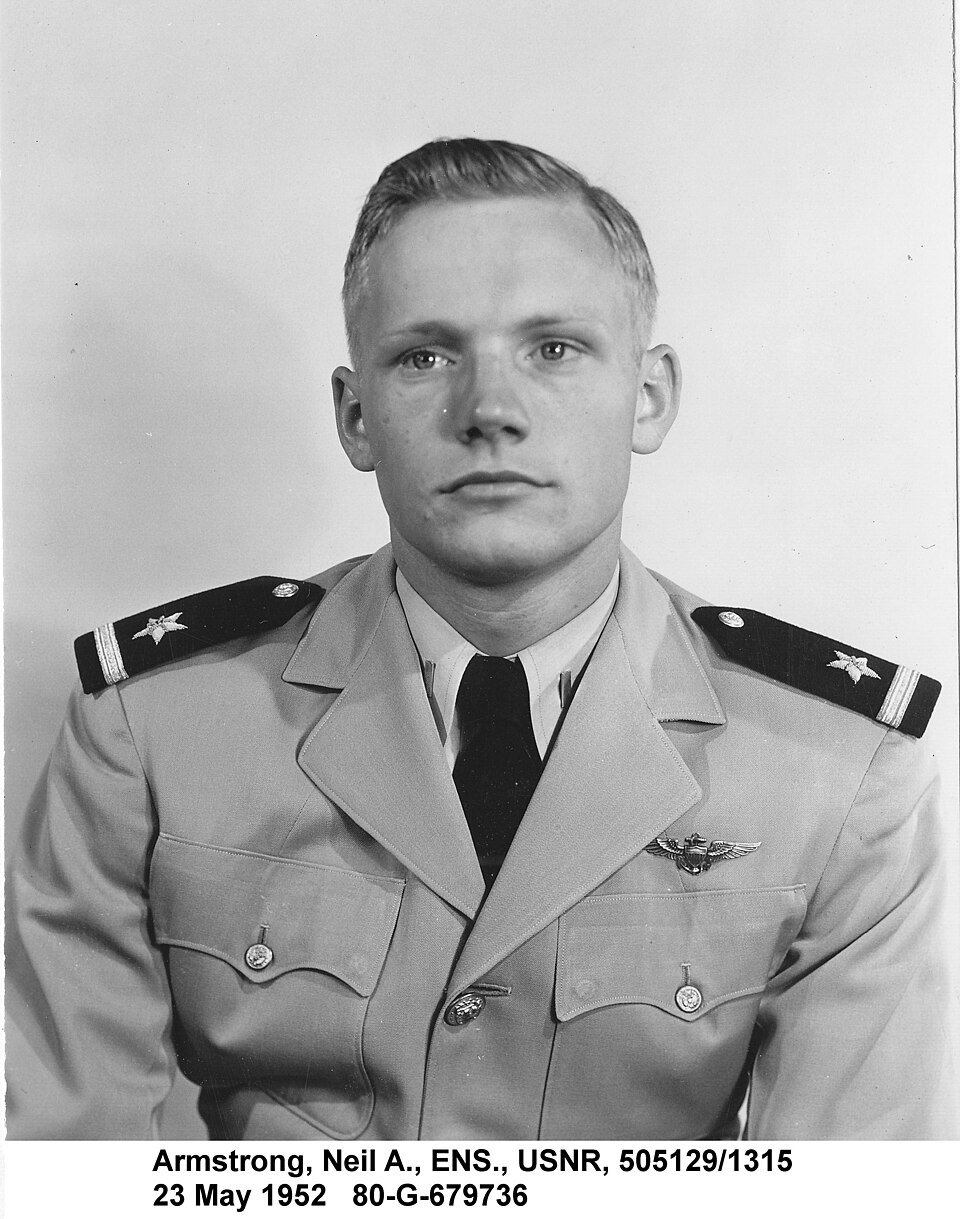

Neil Armstrong
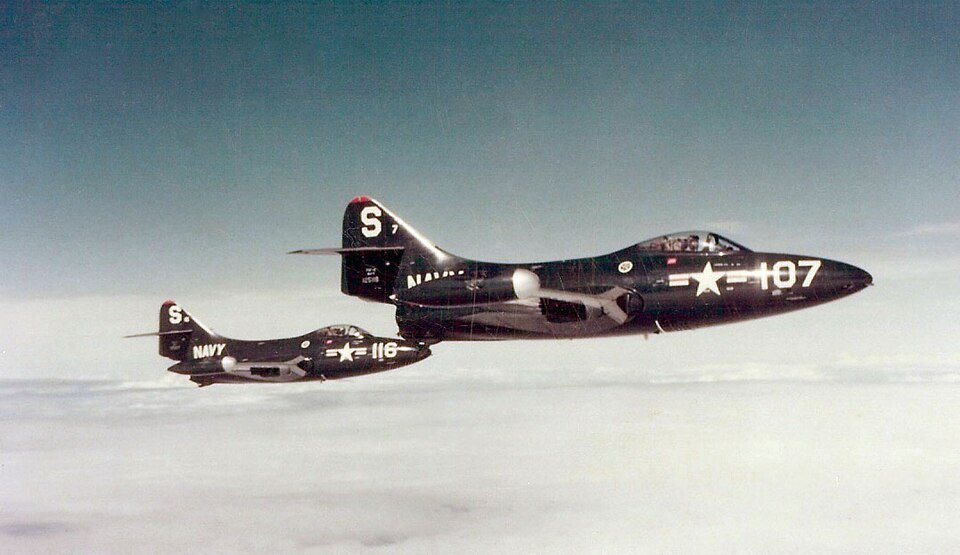
Joined VF-51 on 27 November 1950 and sailed in USS Essex for the 28 June 1951 – 5 March 1952 cruise; first combat mission 29 August 1951[29]. On 3 September 1951, on a low bombing run south of Majon-ni and west of Wonsan, a cable strung across the valley "from mountain to mountain" sliced six to eight feet off the right wing of his F9F-2, BuNo 125122; he flew it back over friendly territory and ejected near K-3 Pohang, where a flight-school roommate, Lt Goodell Warren, picked him up[29, 30]. Some accounts say he was "shot down"; his own account is the cable. He flew 78 missions and 121 hours, received the Air Medal and two Gold Stars, left active duty on 23 August 1952 and, seventeen years later, walked on the Moon. A Navy photo of two VF-51 Panthers over Korea in 1951–52 identifies aircraft S-116 as flown by "Ens. Neil Armstrong" — it is in the gallery[48].
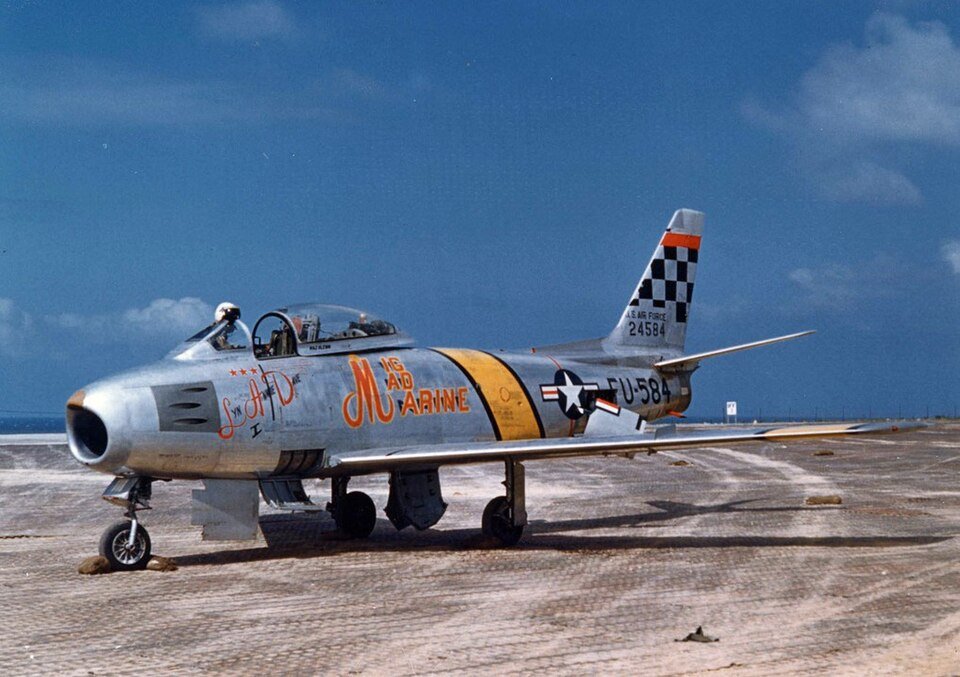

John Glenn
Major Glenn reported to K-3 on 3 February 1953 as operations officer of VMF-311 and flew his first mission, a reconnaissance, on 26 February. Low-level close-air-support runs earned him the nickname "Magnet Ass": after one strike near Sinanju "another 250 or so perforations were found" in his Panther, and a week later a flak hit set off a napalm canister on his wing[31, 32]. He said of the aircraft: "I wouldn't be here today if the Panther weren't such a rugged, rugged plane." After 63 Panther missions he went on exchange to the Air Force's 25th Fighter-Interceptor Squadron, flew 27 F-86 missions and shot down three MiG-15s on 12, 19 and 22 July 1953 — the last air victories of the war[31]. Korea brought him two DFCs — both, their citations show, for the July MiG kills in the Sabre — and eight Air Medals; the Mercury and Senate years followed[31, 32, 18].


Ted Williams
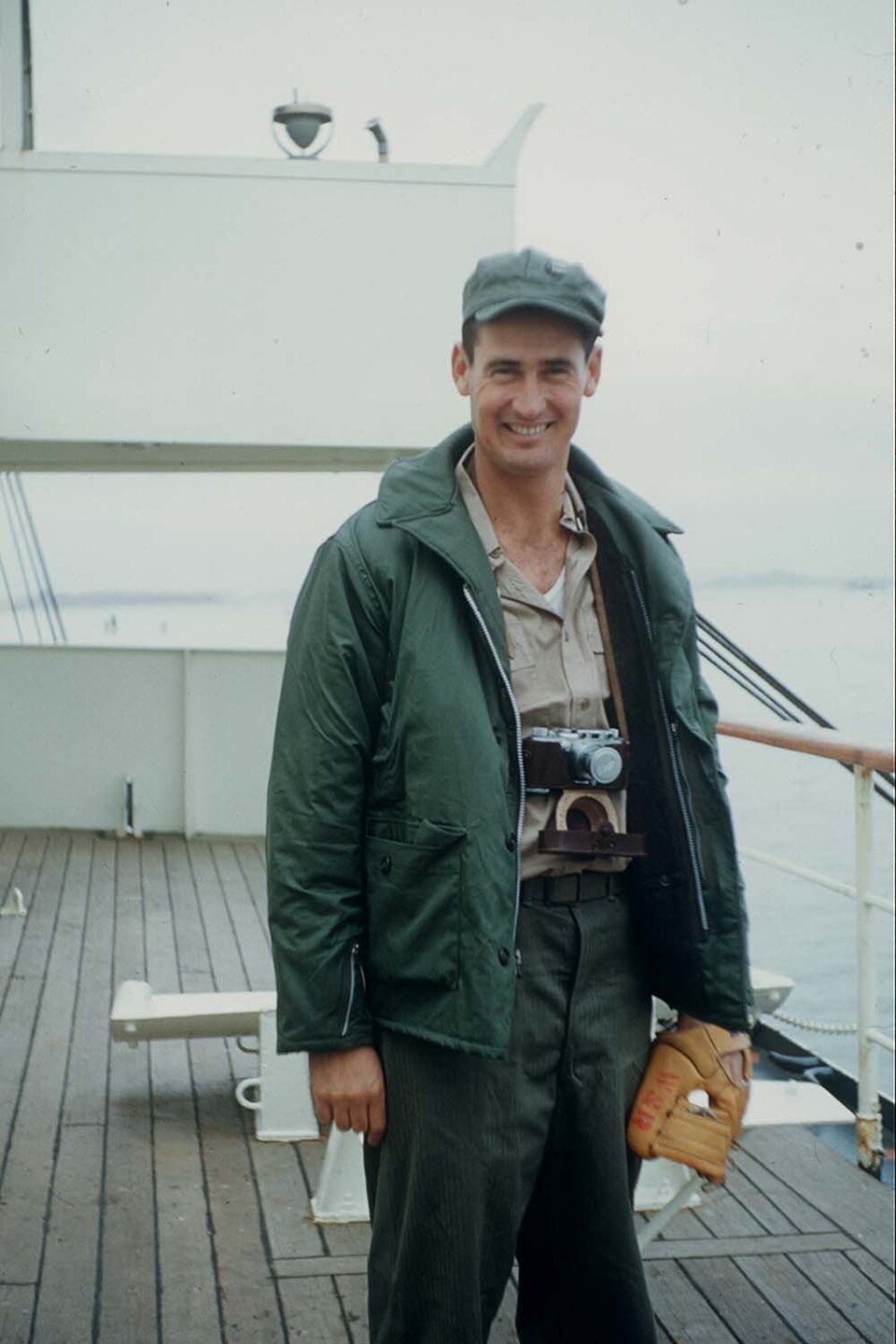
The Boston Red Sox outfielder was recalled on 2 May 1952 and joined VMF-311 (Marine Aircraft Group 33) at K-3 in early February 1953, a few days after Glenn[35, 34]. On 16 February 1953 (19 February by the Baseball Hall of Fame's account) his Panther was hit on a strike against a tank and infantry training complex south of Pyongyang; with the aircraft on fire and no hydraulics he brought it in wheels-up at K-13 Suwon, slid about 1,500 feet and jumped off the wingtip[34, 33]. He flew 37 or 39 missions, about half of them as Glenn's wingman — "Absolutely fearless. The best I ever saw," Williams said of Glenn — was grounded in June 1953 by an old ear problem and released on 28 July 1953 with the Air Medal and two Gold Stars[33, 35]. He hit .407 on his return to Fenway that year.


Numbers
The scoreboard, with its footnotes
| Figure | Value | Source and confidence |
|---|---|---|
| Navy jet air-to-air victories in Panthers, 1950 | 2 Yak-9 (3 Jul); MiG-15s on 9 Nov (Amen), 18 Nov (Lamb/Parker shared; Weber) | [1, 4] — confirmed |
| 18 Nov 1952 fight | 7 MiG-15s engaged; US credits 2 destroyed, 2 damaged; Soviet records at least 4 pilots killed; MoH citation "three destroyed, a fourth severely damaged" | [7, 9, 26] — the four counts are all printed because they differ |
| Panther MiG-15 total, whole war | "7 for 2 Panthers lost" | [39] — Wikipedia only; Polmar says no Panthers lost air-to-air[2] |
| Panther sorties, whole war | about 78,000 | [39] — one cited book; VMF-311 alone flew 18,851[24] |
| Navy & Marine aircraft lost, all types, 37 months | 559 to anti-aircraft fire, 5 in air combat | [25] — confirmed |
| Panthers lost to flak | 57 (Jul 1951 – Jul 1953); 44 of them Jul 1952 – Jul 1953; earlier and accident figures not found | [42] — the one type-by-type source reached; see What was lost |
| Jet : propeller sortie ratio | 1 : 2 in the first six months → 4 : 3 by Feb–Jul 1953 | [25] |
| MiG-15 vs F9F-2 | 680 mph / 51,000 ft vs 526 mph / 44,600 ft; 37 & 23 mm vs four 20 mm | [2] |
| Yalu bridges destroyed by naval air, Nov 1950 | 6 of 17 | [25] |
| Sui-ho strike, 23 Jun 1952 | 35 AD + 35 F9F (24 with 2 × 250-lb bombs); 5 Navy aircraft hit | [26] |