Page 2 · Specifications · Performance · Deployments
A straight wing, a British engine and a hook that tore the tail off
What Grumman built, what it could do, what it carried, and every carrier deck it is documented on — with the figures traced to the Navy's own characteristics sheets and photo captions, and the conflicts between sources left visible.
Design
Airframe and aerodynamics
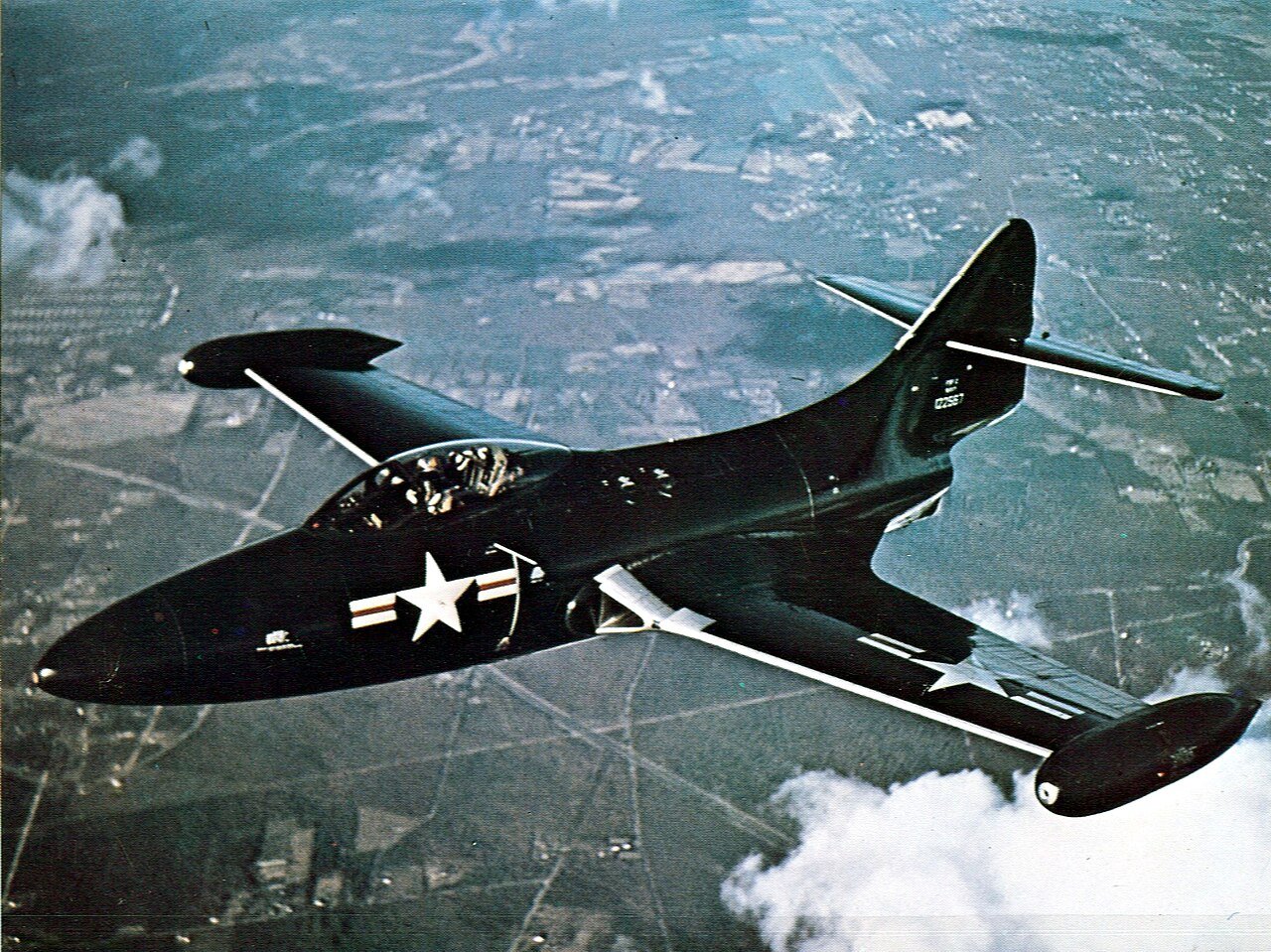
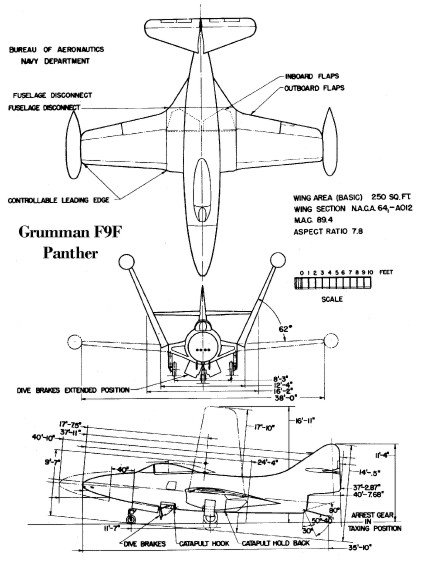
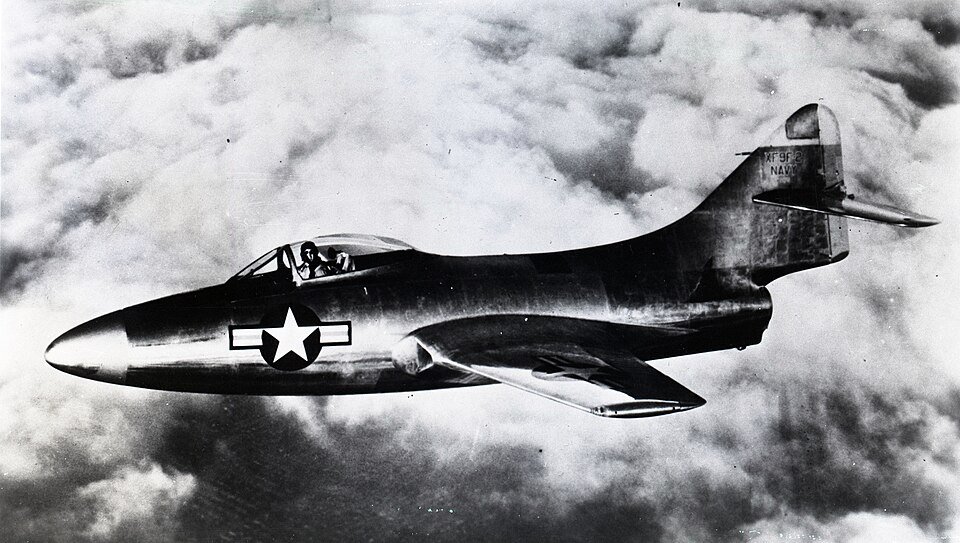
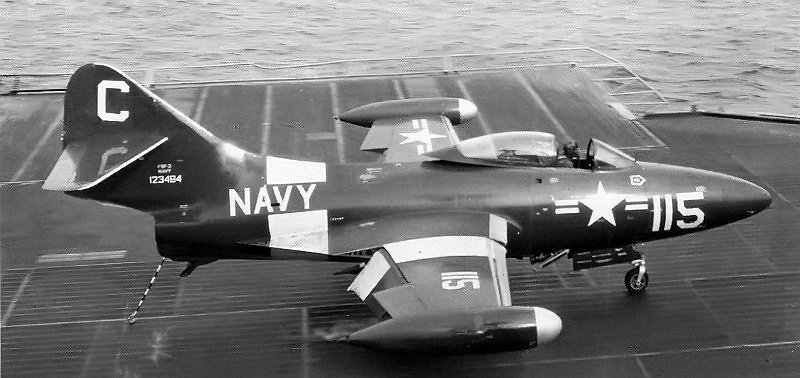
The Panther began life as something else. Grumman's Design G-75 was a two-seat, four-engined night fighter, ordered as the XF9F-1 in April 1946 and beaten by Douglas's XF3D-1 Skyknight. The Navy did not cancel the contract; it rewrote it to cover three prototypes of an entirely different single-seat, single-engine day fighter, Design G-79[2, 1]. That aircraft — an all-metal, mid-wing, straight-wing jet with tricycle gear, hydraulically folding wings, a pressurised and air-conditioned cockpit and an ejection seat — is the Panther[2].
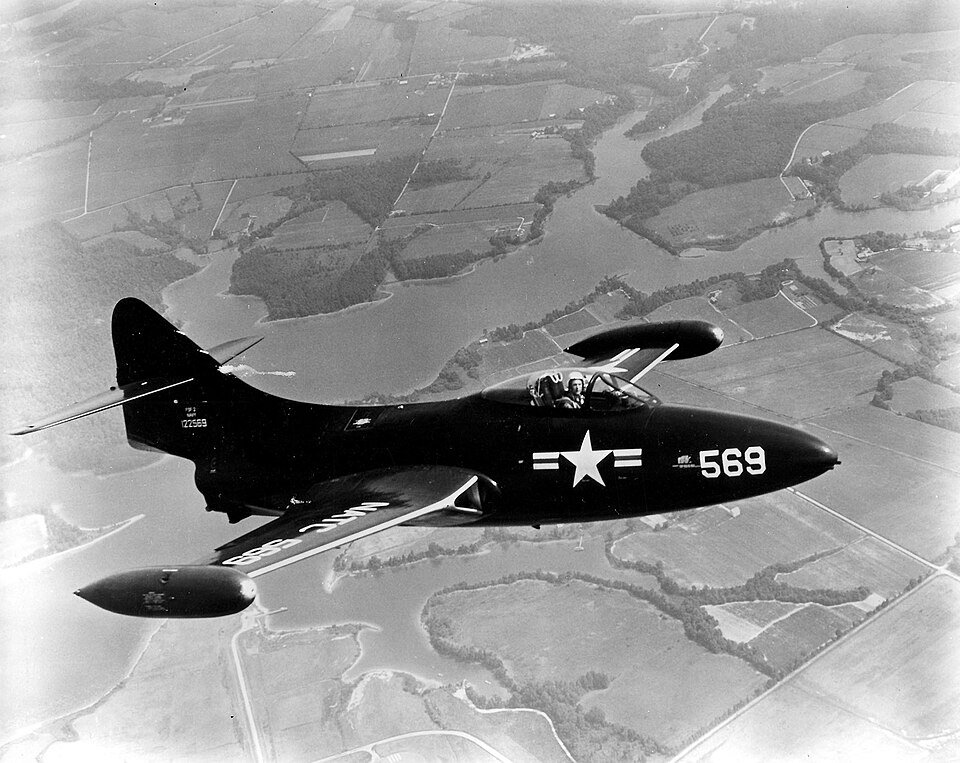
Its distinguishing features were practical ones. A pair of permanently fixed 120-US-gallon wingtip tanks, tried on the first prototype and standard from the 13th production F9F-2, solved a fuel problem (there was not enough room in the wing and fuselage) and had "the incidental advantage of improving the fighter's rate of roll"[2, 1]. A split, perforated speed brake sat under the fuselage behind the nosewheel doors; leading-edge flaps added lift for the approach; the tail and nose sections came off as units for maintenance[2, 1]. The F9F-4 later became the first type to use engine bleed air successfully for blown flaps, cutting stall speed by 9 knots on take-off and 7 on approach[1].
Two things the design earned early. Toughness: John Glenn brought one home from Korea with a hole in the fin "big enough to put my head and shoulders through" and said "I wouldn't be here today if the Panther weren't such a rugged, rugged plane"[6]. And a lesson about hooks: on the first arrested-landing test at Patuxent River the arresting hook pulled the whole tail section off, and Grumman strengthened the tail joint before the fleet got it[6]. The second prototype was lost in that trials programme on 28 October 1948[2].


Powerplants
Three engines, two of them British
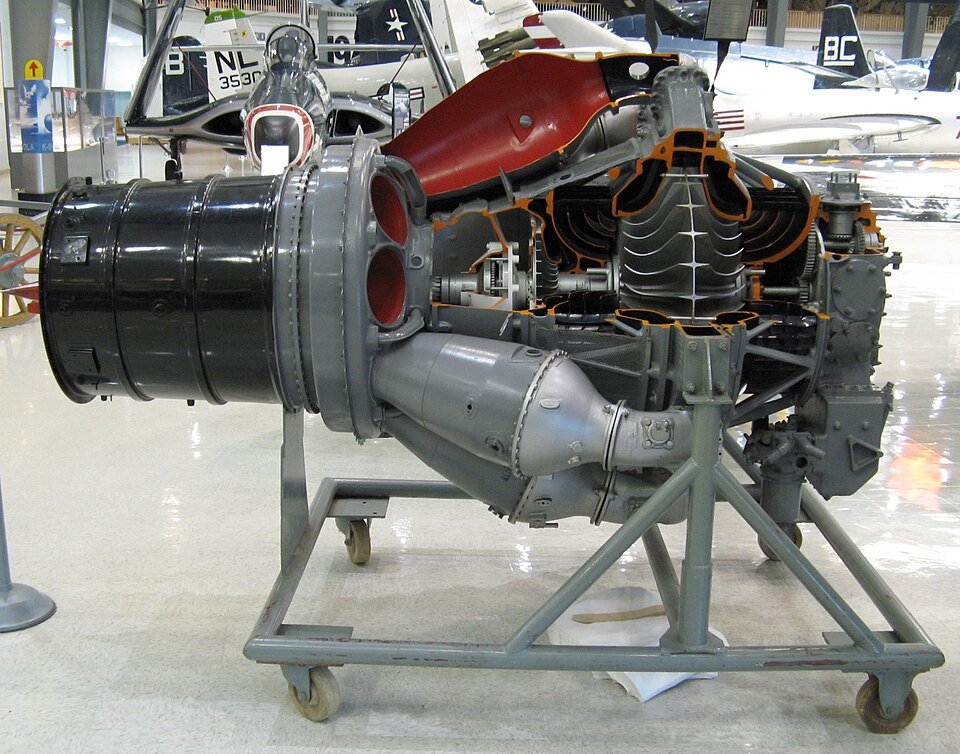
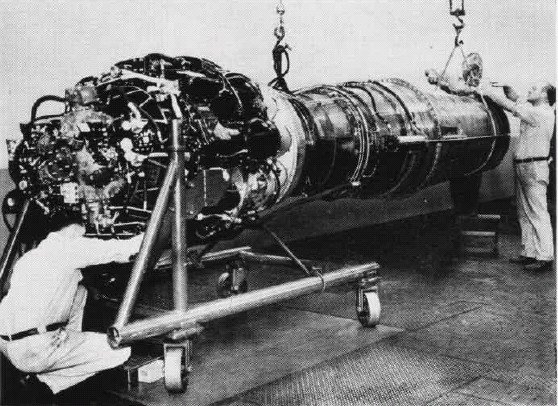
American turbojets of 1946 — the Allison J33 and Westinghouse J34 — were not judged reliable enough for a carrier fighter, so the Navy specified the imported Rolls-Royce Nene of about 5,000 lbf, and in 1947, "at the behest of the United States Navy", Pratt & Whitney agreed to build it under licence as the J42[4, 2]. The prototypes flew on British-built Nenes because J42 production had not started. As insurance against the J42 failing, the Navy also ordered Panthers with the Allison J33 — the F9F-3 — which proved the weaker engine and were all re-engined with the J42[1, 5].
Pratt & Whitney then asked Rolls-Royce for something bigger. The result was the Tay, about 30 per cent larger than the Nene, produced in the United States as the J48 and fitted to the definitive F9F-5[4]. Both the J42 and the J48 used water (later water-alcohol) injection for take-off, which is why every Panther engine has two thrust figures[2].
| Variant | Engine | Dry thrust | Wet (water injection) | Source |
|---|---|---|---|---|
| XF9F-2 | Rolls-Royce Nene (imported) | ≈5,000 lbf | — | [1, 2] |
| F9F-2 | Pratt & Whitney J42-P-6 / J42-P-8 (licence Nene) | 5,000 lbf | 5,750 lbf | [2, 5] |
| F9F-3 | Allison J33-A-8 | 4,600 lbf | — | [2, 5] |
| F9F-4 | Allison J33-A-16 | 6,250 lbf | 6,950 lbf | [2, 5] |
| F9F-5 / F9F-5P | Pratt & Whitney J48-P-2, -P-4, -P-6A (licence Tay) | 6,250 lbf | 7,000 lbf | [4, 2, 1] |



Specifications
Dimensions and weights by variant
| Figure | F9F-2 (J42) | F9F-5 (J48) | Notes |
|---|---|---|---|
| Length | 37 ft 5⅜ in | 38 ft 10 in | The F9F-4/-5 forward fuselage is 19.5 in longer[5]; F9F-5P camera nose adds another 14.6 in, to 40 ft[2] |
| Wingspan (over tip tanks) | 38 ft 0 in | 38 ft 0 in | |
| Height | 11 ft 4 in | 12 ft 3 in | Taller fin on the F9F-4/-5 |
| Wing area | 250 sq ft | 250 sq ft | Confirmed for the F9F-5; the wing was unchanged |
| Empty weight | 9,303 lb | 10,147 lb | |
| Gross / loaded weight | 19,494 lb | 18,721 lb | Different definitions: the museum figure for the F9F-2 is probably maximum take-off; the F9F-5 figure is the characteristics sheet's combat gross weight |
| Fuel (internal + tip tanks) | 923 US gal | 1,003 US gal | Two fixed 120-gal tip tanks; a 150-gal drop tank could go on the inboard pylon[2, 5] |
| Sources | [3] | [1, 2] | F9F-3 = F9F-2 airframe with a J33; F9F-4 = F9F-5 airframe with a J33-A-16. Separate F9F-3/-4 figures were not found. |

Performance
What the numbers say — and where they disagree
| Figure | F9F-2 | F9F-5 | Conflicts |
|---|---|---|---|
| Maximum speed | 575 mph at sea level[3] | 503 kn / 579 mph at 5,000 ft[1] | AirVectors prints 625 mph "at altitude"[2] — out of line with the Navy sheet for a straight-wing jet; treat with caution |
| Cruising speed | not found | 418 kn / 481 mph[1] | |
| Initial climb | not found | 5,090 ft/min[1] | |
| Service ceiling | 44,600 ft[3] | 42,800 ft[1] | 42,650 ft in AirVectors[2] |
| Range | 1,353 mi[3] | 1,100 nmi / 1,300 mi[1] | 1,130 nmi in AirVectors; no source states the load condition |
| Stall speed change with blown flaps (F9F-4) | −9 kn take-off, −7 kn approach[1] | The only approach-speed figure found | |
Two comparisons put the figures in context. Against the MiG-15 the Panther was slow and low: about 680 mph and 51,000 ft for the MiG against 526 mph and 44,600 ft for the F9F-2 in Norman Polmar's tabulation — but the straight wing "could easily turn inside the MiG-15", which is how Panthers shot down MiGs anyway[6]. Against its own stablemates it was the easy one: a former Panther pilot told Air & Space that his tailhook "would bounce up and down across the deck" and put him in the barricade repeatedly, yet the type earned a reputation as a forgiving deck aeroplane compared with the F2H Banshee and F7U Cutlass[6].
The fuel figures explain the tactics. A centrifugal-flow turbojet at low altitude drinks fuel — a civilian Panther pilot recalled that "you could literally watch the fuel gauge needles move"[6] — which is why Panthers flew short, sharp flak-suppression and escort sorties and why F9F-5 BuNo 126204, photographed over Korea on 14 June 1953, ran out of fuel and ditched five days later[13].
Armament
Four cannon, eight pylons and one experiment with a turret
Every Panther carried four 20 mm M3 cannon under the nose, 190 rounds per gun, aimed with a Mk 8 computing optical sight and no radar[2, 1]. That is the battery Royce Williams emptied — all 760 rounds — into six MiG-15s on 18 November 1952 (see Combat & Awards).
Bombs and rockets came with the F9F-2B, a designation for F9F-2s fitted with underwing pylons about halfway through production; once every F9F-2 had been retrofitted the "B" was dropped[2, 1]. The F9F-5 carried eight pylons, four a side: the heavy inboard station took a 1,000-lb bomb or a 150-gal drop tank, the three outer stations 250-lb bombs or 5-inch HVAR rockets[2]. The maximum external load is printed three ways — 2,000 lb[2], 3,000 lb[3] and 3,465 lb[1] — depending on the source and the variant, so this page prints all three rather than choose.
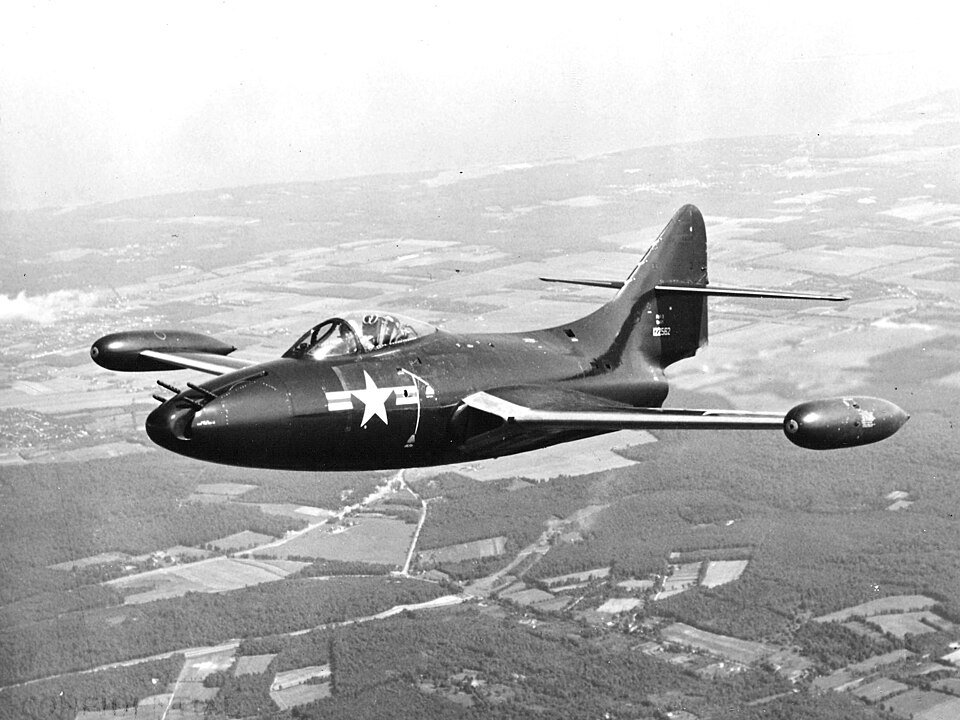
The strangest Panther was F9F-3 BuNo 122562, fitted at Patuxent River with the Emerson Aero X17A nose turret: four .50-calibre machine guns in a nose that could roll through 360° and traverse from dead ahead to 20° aft, aimed by radar, so a single-seat fighter could attack a bomber from any angle without sitting behind its tail gunner. The fire-control electronics were too big and heavy for a single-seater and the project was cancelled after aerodynamic flight testing[7].



Carrier operations
Learning to land a jet on a straight deck
The Panther reached the fleet in May 1949, when VF-51 received the first aircraft; carrier-suitability trials began the same month and the type was cleared for carrier operations in September 1949[3, 1]. The Marines followed: on 20 November 1950 VMF-115 became the first Marine squadron to carrier-qualify all eighteen of its pilots, aboard USS Franklin D. Roosevelt[11].
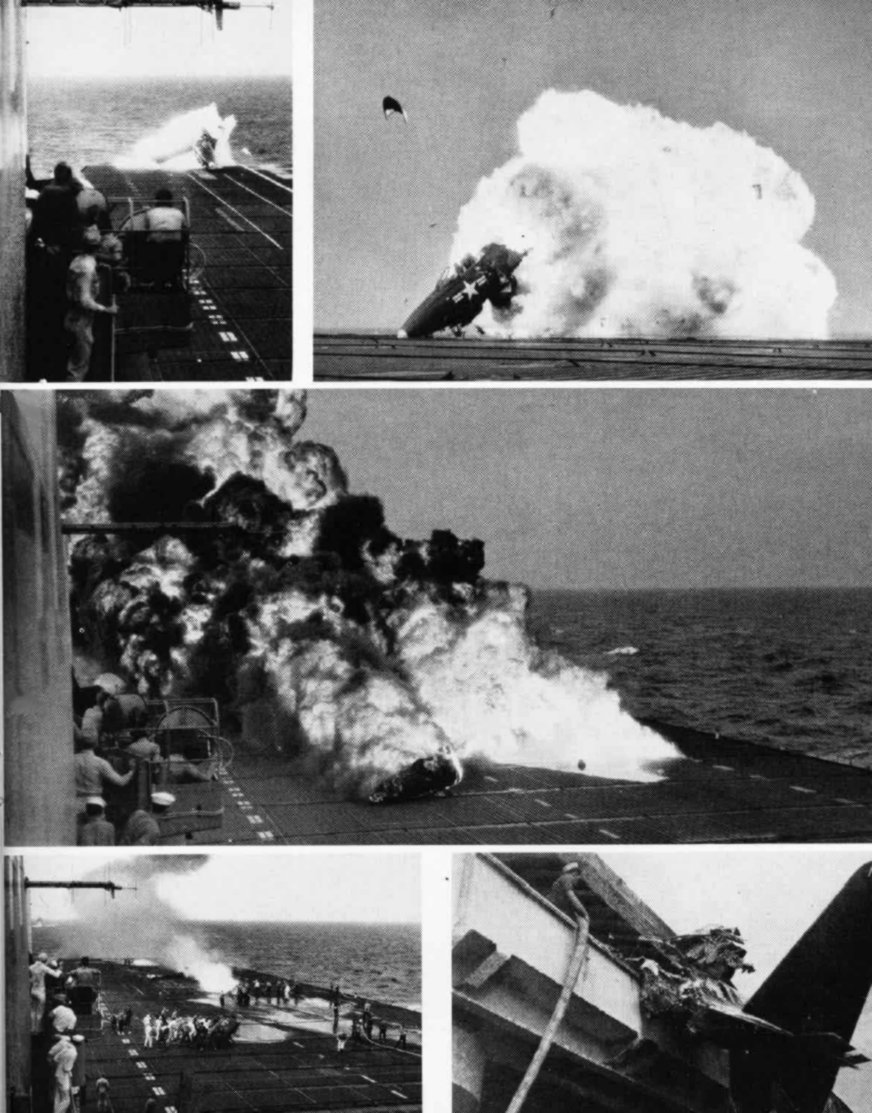
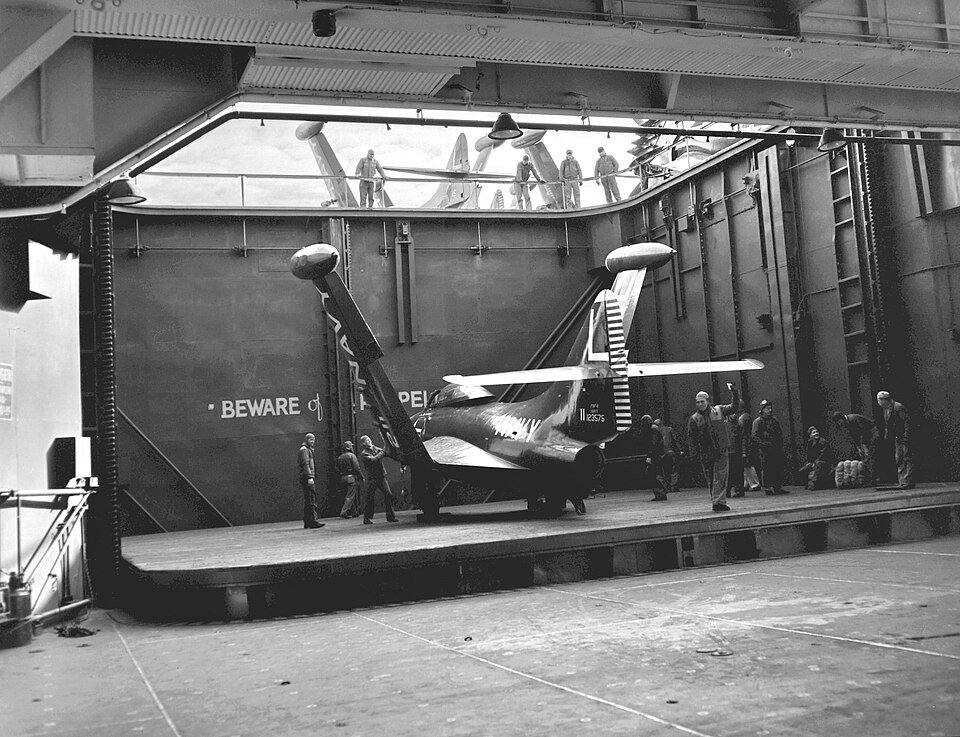
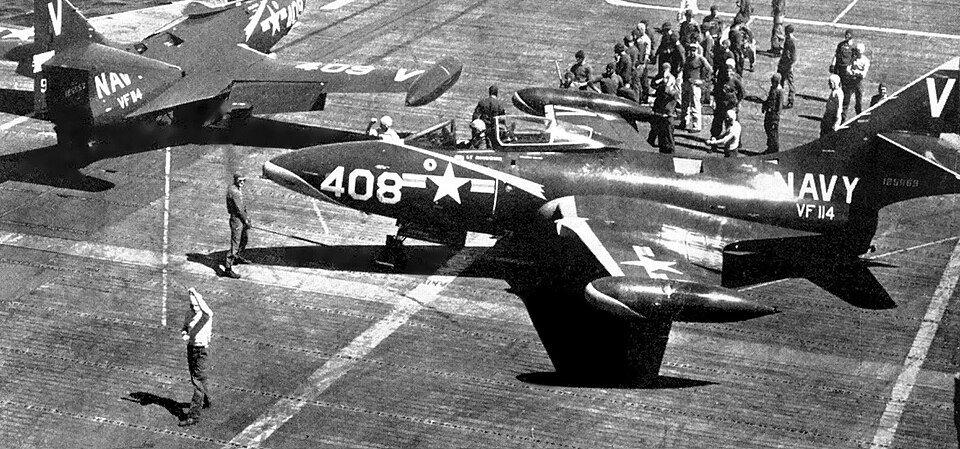
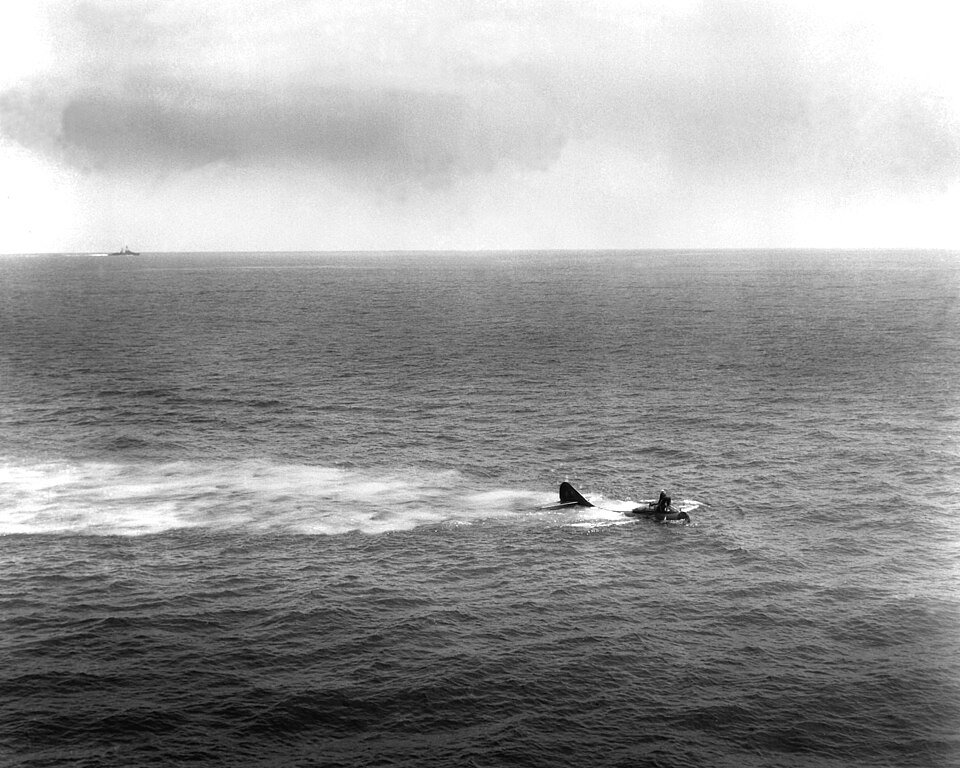
The carriers of 1950 were straight-deck Essex- and Midway-class ships with hydraulic catapults and a Davis barrier strung across the deck to stop an aircraft that missed the wires. A jet arrived at the ramp faster than a Corsair, its centrifugal engine answered the throttle slowly, and a bounced hook meant the barricade. The photographs on this page show what that looked like: an F9F-2 hanging from Philippine Sea's bow after a catapult bridle broke; a VF-781 Panther whose entire nose section "came off the plane and careened into the sea" on landing; a Naval Air Test Center Panther striking Midway's ramp on 23 July 1951, its cockpit section breaking away and rolling up the deck with the pilot, Cdr George C. Duncan, surviving with minor injuries[13].
The Navy paid for those lessons in aircraft. One widely quoted figure — 776 Navy and Marine aircraft lost in a year, a rate of 54 major mishaps per 10,000 flying hours, falling to 19 by 1961 — is attributed to 1950 in one source and to 1954 in most others, so it is printed here as an order of magnitude, not a Panther statistic[10]. What changed the odds was not the Panther but the deck: the angled deck, first fitted to USS Antietam in late 1952, let a jet that missed the wires simply fly away, and the 1953 demonstration photo below shows Skyraiders taking off from the angle while a Panther goes down the catapult[13, 10].






Deployments
Every carrier the Panther is documented aboard
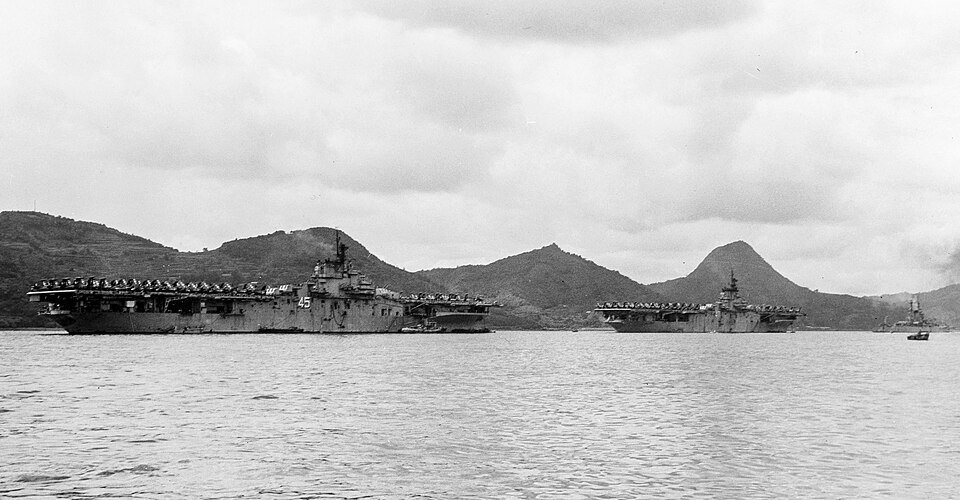
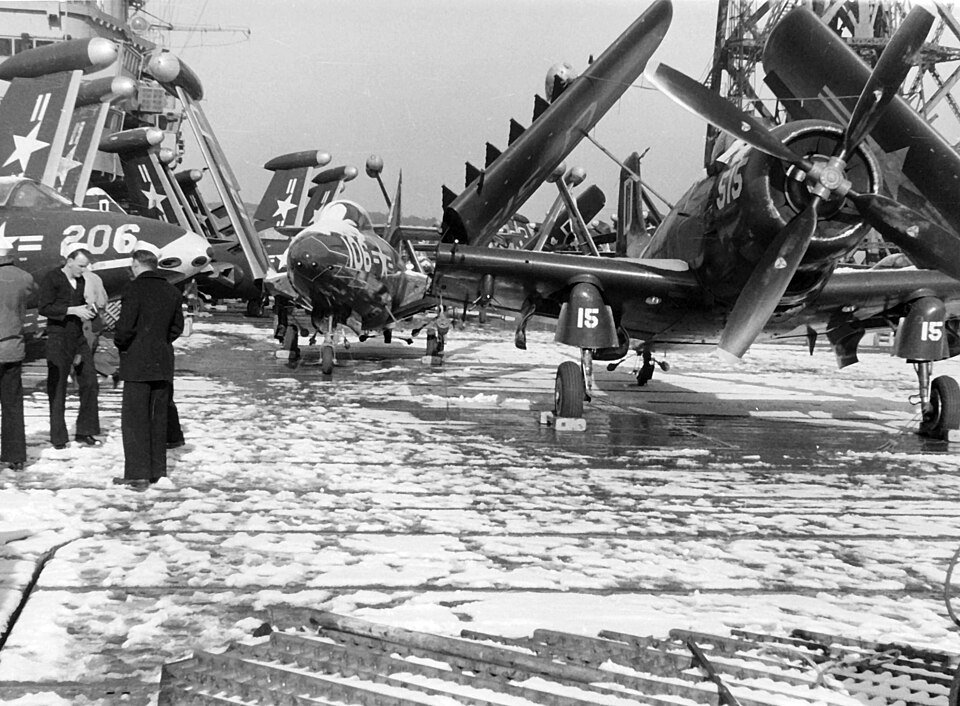
Thirty-six deployments are listed, Korean War cruises first. "Confirmed" rows rest on a squadron history or an official Navy photograph caption that names the carrier, the air group, the squadron, the aircraft and the dates; "partial" rows have one of those pieces missing. The Naval History and Heritage Command's Appendix 25 is the definitive list and could not be retrieved for this build — rows marked partial should be checked against it before they are quoted[24]. The Naval Reserve squadrons (VF-721, VF-781, VF-783, VF-821, VF-831, VF-837) are the Weekend Warriors of the home page.
| Carrier | Air group | Panther squadron(s) | Dates | Theatre | Notes | Status |
|---|---|---|---|---|---|---|
| USS Valley Forge (CV-45) | CVG-5 | VF-51, VF-52 (F9F-3, re-engined to F9F-2 standard) | 1 May – 1 Dec 1950 | Korea — Task Force 77 | First Navy jet combat, 3 July 1950; first Navy jet air-to-air kills (two Yak-9s). [1, 3, 13] | confirmed |
| USS Philippine Sea (CV-47) | CVG-11 | VF-111, VF-112 (F9F-2B) | 5 Jul 1950 – 26 Mar 1951 | Korea | Lt Cdr Amen’s MiG-15, 9 Nov 1950 — the Navy’s first jet-versus-jet kill. [13, 20] | confirmed |
| USS Leyte (CV-32) | CVG-3 | VF-31 (F9F-2) | 6 Sep 1950 – 3 Feb 1951 | Korea | Ens. Weber’s MiG-15, 18 Nov 1950. Leyte came from the Atlantic Fleet. [13] | confirmed |
| USS Princeton (CV-37) | CVG-19 | VF-191 (F9F-2) | 9 Nov 1950 – 29 May 1951 | Korea | VF-191 was built around the disbanded Blue Angels; its CO, Lt Cdr John Magda, was killed 8 March 1951. [17, 13] | confirmed |
| USS Boxer (CV-21) | CVG-101 (Naval Air Reserve) | VF-721 (F9F-2B) + VC-61 det. (F9F-2P) | 2 Mar – 24 Oct 1951 | Korea | First Naval Reserve pilots to strike in Korea — the Glenview "Weekend Warriors". [16, 13] | confirmed |
| USS Bon Homme Richard (CV-31) | CVG-102 (Naval Air Reserve) | VF-781 (F9F-2B) | 10 May – 17 Dec 1951 | Korea | Los Alamitos reservists. [15, 13] | confirmed |
| USS Essex (CV-9) | CVG-5 | VF-51 (F9F-2) + VC-61 Det. B (F9F-2P) | 26 Jun 1951 – 25 Mar 1952 | Korea | Ens. Neil Armstrong ejected 3 Sep 1951. Essex also carried the first F2H Banshees in combat. [13, 21] | confirmed |
| USS Antietam (CV-36) | CVG-15 (Naval Air Reserve) | VF-831, VF-837 (F9F-2 / F9F-2B) | 8 Sep 1951 – 2 May 1952 | Korea | Her only combat deployment; nearly 6,000 sorties by the air group. [13] | confirmed |
| USS Valley Forge (CV-45) | ATG-1 | VF-111 (F9F-2); VF-52 | 15 Oct 1951 – 3 Jul 1952 | Korea | VF-111 confirmed in F9F-2s; VF-52’s aircraft type on this cruise not confirmed. [13, 14] | partial |
| USS Boxer (CV-21) | CVG-2 | VF-24 (F9F-2) | 8 Feb – 26 Sep 1952 | Korea | Hangar-deck fire 5 Aug 1952 killed eight. [13] | confirmed |
| USS Princeton (CV-37) | CVG-19 | VF-191 (F9F-2) | 21 Mar – 3 Nov 1952 | Korea | [17] | confirmed |
| USS Bon Homme Richard (CVA-31) | CVG-7 | VF-71, VF-72 (F9F-2) + VC-61 Det. N (F9F-2P) | 20 May 1952 – 8 Jan 1953 | Korea | Sui-ho power-plant strike 23–25 June 1952; Thanksgiving Day strike 27 Nov 1952. [13] | confirmed |
| USS Essex (CV-9) | ATG-2 | VF-821 (F9F-2, Naval Air Reserve) | 16 Jun 1952 – 6 Feb 1953 | Korea | [13] | confirmed |
| USS Kearsarge (CVA-33) | CVG-101 | VF-721 (F9F-2) | 11 Aug 1952 – 17 Mar 1953 | Korea | [16] | confirmed |
| USS Oriskany (CVA-34) | CVG-102, redesignated CVG-12 on 4 Feb 1953 | VF-781, VF-783 (F9F-5) — became VF-121, VF-122 | 15 Sep 1952 – 18 May 1953 | Korea | Lt Royce Williams’s fight with seven Soviet MiG-15s, 18 Nov 1952. VF-783 lost four F9F-5s. [13, 15, 19] | confirmed |
| USS Valley Forge (CVA-45) | CVG-5 | VF-51 (F9F-5) + VC-61 Det. B (F9F-5P) | 20 Nov 1952 – 25 Jun 1953 | Korea | The Topeka museum’s F9F-5, BuNo 126226, flew VF-51’s combat here, 2 Jan – 5 Mar 1953. [13, 22] | confirmed |
| USS Philippine Sea (CVA-47) | CVG-9 | VF-91 (F9F-2); VF-93 | 15 Dec 1952 – 14 Aug 1953 | Korea | VF-91 confirmed; VF-93 "Blue Blazers" in F9F-2s appears in a Navy caption dated only "circa 1952". [13, 18] | partial |
| USS Princeton (CVA-37) | CVG-15 | VF-153, VF-154 (F9F-5) | 24 Jan – 21 Sep 1953 | Korea | VF-154 confirmed by a 13 May 1953 Navy photo; VF-153 (ex-VF-831) per its squadron history. [13] | partial |
| USS Boxer (CVA-21) | ATG-1 | VF-111 (F9F-5), VF-151 (F9F-2) | 30 Mar – 28 Nov 1953 | Korea | The Pensacola museum’s F9F-2, BuNo 123050, flew with VF-151 here until a barrier crash. A Navy caption dates VF-111’s time aboard as 30 March – 30 June 1953 only. [13, 20] | confirmed |
| USS Lake Champlain (CVA-39) | CVG-4 | VF-111 (F9F-5) | summer 1953 | Korea | Squadron history only; dates and type not independently confirmed. [20] | partial |
| USS Franklin D. Roosevelt (CVB-42) | — | VMF-115 carrier qualification; VMF-223 (F9F-2) embarked | 20 Nov 1950; Sep – Dec 1950 | Atlantic | VMF-115 qualified all 18 pilots in a day; a Navy photo shows VMF-223 Panthers on FDR’s deck-edge elevator. [11, 13] | confirmed |
| USS Franklin D. Roosevelt (CVB-42) | CVG-6 | VF-61 (F9F-2) | 10 Jan – 18 May 1951 | Mediterranean — Sixth Fleet | [13] | confirmed |
| USS Leyte (CV-32) | CVG-3 | VF-31 (F9F-2) | 3 Sep – 21 Dec 1951 | Mediterranean | [13] | confirmed |
| USS Midway (CVB-41) | CVG-6 | VF-21 (F9F-2) | 9 Jan – 5 May 1952 | Mediterranean | Midway also hosted Naval Air Test Center Panther trials (the 23 July 1951 ramp strike, below). [13] | confirmed |
| USS Coral Sea (CVA-43) | CVG-8 | VF-83 (F9F-5) | 26 Apr – 21 Oct 1953 | Mediterranean | [13] | confirmed |
| USS Tarawa (CVA-40) | CVG-3 | VF-43 (F9F-5) | 12 Nov 1953 – 6 Sep 1954 | Round-the-world cruise | [13] | confirmed |
| USS Lake Champlain (CVA-39) | CVG-8 | VF-84 (F9F-5) | 28 Sep 1954 – 22 Apr 1955 | Mediterranean | [13] | confirmed |
| USS Yorktown (CVA-10) | CVG-2 | VF-63, VF-64 (F9F-5) | 1953–54 | Western Pacific | Inferred from the CAG-2 aircraft photo used as this site’s home-page hero; dates not confirmed. [13] | partial |
| USS Kearsarge (CVA-33) | CVG-11 | VF-113 (F9F-5) | 1 Jul 1953 – 18 Jan 1954 | Western Pacific | [13] | confirmed |
| USS Oriskany (CVA-34) | CVG-19 | VF-192 (F9F-5) | 14 Sep 1953 – 22 Apr 1954 | Western Pacific | Oriskany doubled as the carrier in the 1954 film The Bridges at Toko-Ri. [13] | confirmed |
| USS Kearsarge (CVA-33) | CVG-11 | VF-114 (F9F-5) | 7 Oct 1954 – 12 May 1955 | Western Pacific | [13] | confirmed |
| USS Essex (CVA-9) | CVG-2 | VF-64 (F9F-5) | 3 Nov 1954 – 21 Jun 1955 | Western Pacific | [13] | confirmed |
| USS Wasp (CVA-18) | — | VF-52 | 1 Sep 1954 – 11 Apr 1955 | Western Pacific | Squadron history gives the cruise; aircraft type not stated. [14] | partial |
| USS Philippine Sea (CVA-47) | ATG-2 | VF-123 (F9F-2) | 1 Apr – 23 Nov 1955 | Western Pacific | Among the last F9F-2 fleet deployments. [13] | confirmed |
| USS Wasp (CVA-18) | CVG-15 | VMA-223 (F9F-5, Marine Corps) | 23 Apr – 15 Oct 1956 | Western Pacific | Marine Panthers at sea in the type’s final fleet year. [13] | confirmed |
| USS Antietam (CVS-36) | — | VF(AW)-4 Det. 50 (F9F-5) | 1956 | Atlantic | Navy caption; a late all-weather detachment aboard the angled-deck training carrier. [13] | partial |






Beyond the carriers
Marines ashore, the Blue Angels, Argentina and NACA
Marine Corps, land-based
VMF-311 and VMF-115
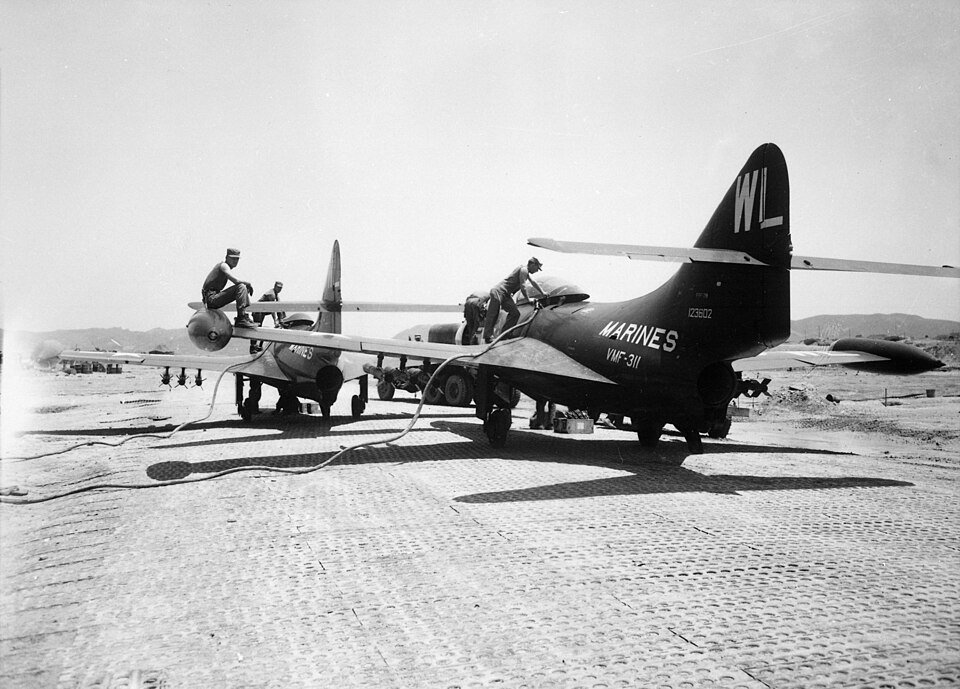
VMF-311 took Panthers in October 1949 and reached Korea in December 1950, the first land-based Marine jet squadron in combat; it flew 18,851 combat sorties over two and a half years, and John Glenn and Ted Williams flew with it in 1953[12]. VMF-115, the first Marine F9F-2 squadron (1949), deployed to Pohang in February 1952 and flew 9,250 combat sorties in 15,350 hours, losing 19 aircraft; it kept F9F-2s and J33-powered F9F-4s until the F4D Skyray arrived in spring 1957[11]. VMF-223 embarked in FDR in 1950, and VMA-223 was still flying F9F-5s from USS Wasp in 1956[13].
Flight demonstration
The Blue Angels' first jet
The team moved from the F8F Bearcat to the F9F-2 and flew its first jet show at Beaumont, Texas, on 20 August 1949. Disbanded for Korea in 1950, its pilots became the nucleus of VF-191 aboard Princeton; the team re-formed on 25 October 1951 at Corpus Christi under Lt Cdr Roy "Butch" Voris on the F9F-5, and moved to the swept-wing F9F-8 Cougar in December 1954[8]. A January 1954 photograph over NAS Jacksonville identifies three of the team's F9F-5s as BuNos 125258, 125294 and 125305[13].
The only export customer
Argentina
The Comando de Aviación Naval bought 28 ex-Navy F9F-2Bs in late 1957 — 24 to fly, four for spares. The first ten arrived at Puerto Belgrano in August 1958 aboard ARA Bahía Buen Suceso. On 27 July 1963 Panther 0453/3-A-119, flown by Capitán de Fragata Justiniano Martínez Achaval, made the Argentine Navy's first jet landing on a carrier, ARA Independencia — but the ship's catapult was too weak to launch it and the aircraft was craned off. Rebel Panthers attacked an Army tank column in the April 1963 naval revolt. Last flight 3 March 1970; struck off 9 June 1971[9, 1].
Research
NACA and the test centres
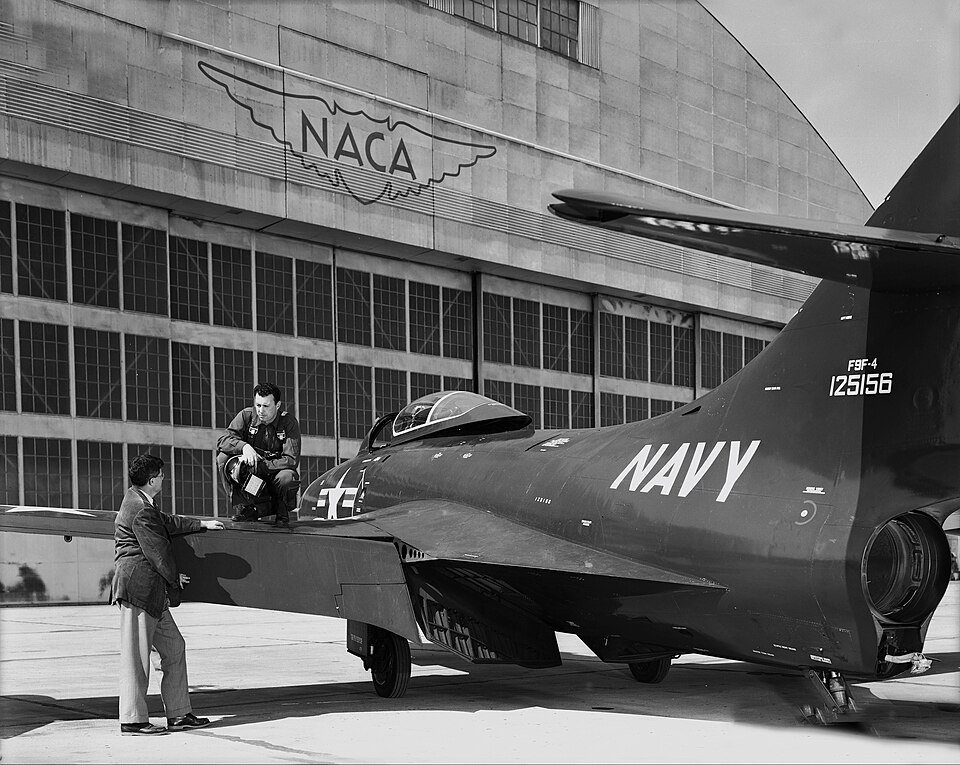
Panthers served the National Advisory Committee for Aeronautics at Langley and Ames — an F9F-4 was on the Ames ramp in August 1955, and F9F-2 BuNo 122560 (built as an F9F-3) was still flying handling-qualities tests at Langley when NACA became NASA on 1 October 1958[13]. The Naval Air Test Center at Patuxent River flew the turret aircraft, the in-flight refuelling trials with an AJ Savage tanker, and the carrier trials that cost a prototype its tail[7, 13].