Page 6 · Variants · Evolution · the missing link to the Cougar
From a four-engined night fighter to a swept wing in five years
The Panther's family tree runs from a design that was never built, through three engines and two fuselage lengths, to the day in September 1951 when Grumman swept its wing 35° and called the result a Cougar. Here is every variant, the production arithmetic, and why the sweep mattered.
1946–1948
Origins: the fighter that replaced itself
On 11 April 1946 Grumman received a contract for two G-75 experimental aircraft, designated XF9F-1: a two-seat night fighter with four Westinghouse J30 turbojets of about 3,000 lbf each[10, 2]. It lost the night-fighter competition to Douglas's XF3D-1 Skyknight, and Grumman itself concluded the design "did not have much potential for either performance or growth"[10, 1]. The Navy did not cancel. It "changed the wording to include three entirely different G-79 prototypes" — a single-seat, single-engine day fighter[10, 1].
The engine question shaped everything. American turbojets — the Allison J33, the Westinghouse J34 — "were not considered to be sufficiently reliable", so the Navy specified the British Rolls-Royce Nene of about 5,000 lbf, first run in October 1944, and in 1947 had Pratt & Whitney license it as the J42[1, 11, 12]. The J33 stayed in the programme as a hedge: one prototype and 54 production aircraft got it, "as insurance against the failure of the J42"[1, 5].
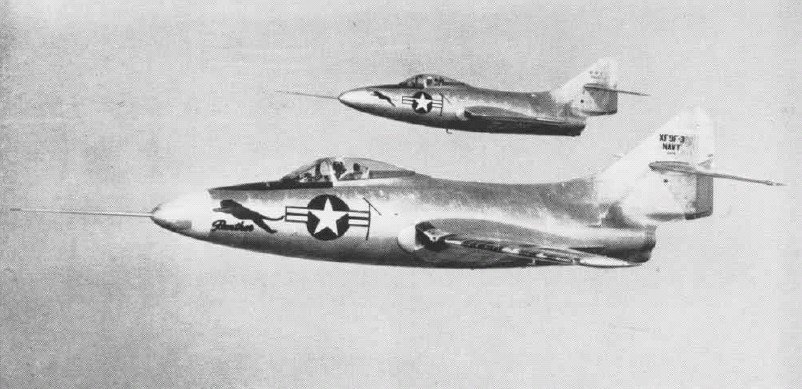
The three G-79 prototypes were XF9F-2 BuNo 122475, first flown at Bethpage by Grumman test pilot Corwin "Corky" Meyer on 21 November 1947; XF9F-2 BuNo 122477, flown on 26 November 1947 and later lost when "the tail was torn off in an arrested landing at NAS Patuxent River" on 28 October 1948; and the Allison-powered XF9F-3 BuNo 122476, flown on 16 August 1948[9, 3, 2]. (One older source gives 24 November for the first flight; the museum, Baugher and AirVectors agree on the 21st.) Because there was "insufficient space within the wings and fuselage for fuel", two 120-gallon tanks were fixed permanently to the wingtips — tried on the first prototype, standard from the 13th production aircraft, and good for the roll rate too[10, 2, 1]. Carrier trials began in May 1949; the type was cleared for carrier operations by September[1].
Who drew it: no source reached names Grumman's design leads on the Panther, so none are printed here.




Variant
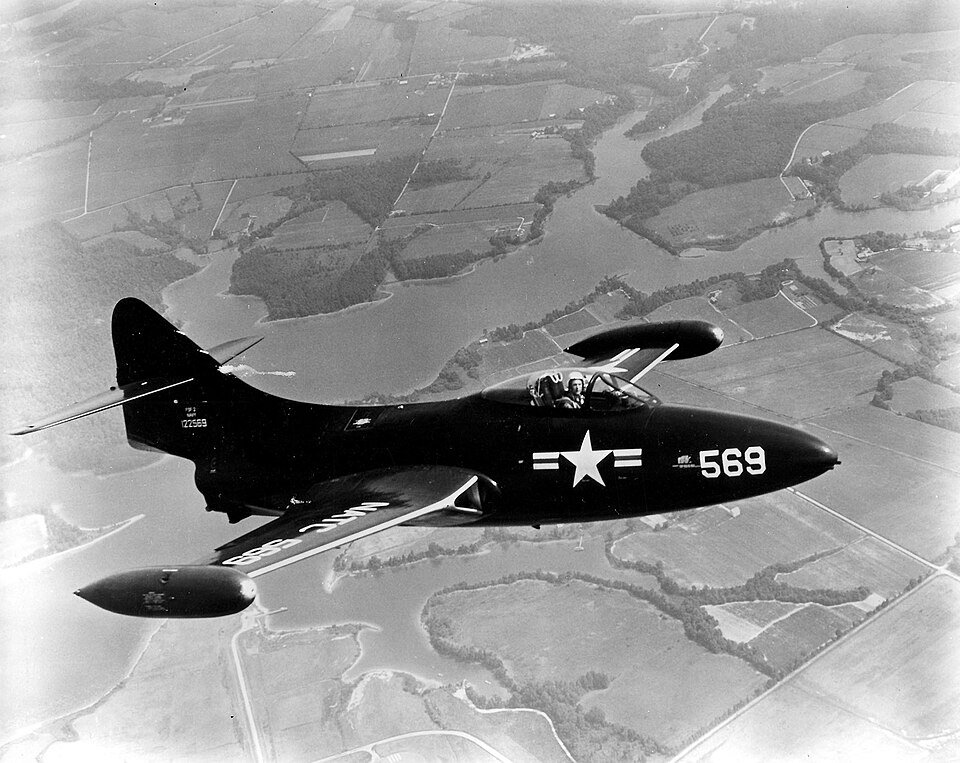
F9F-2 — the first production Panther
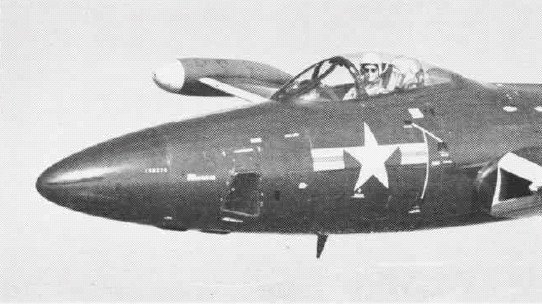
Engine: J42-P-6, then J42-P-8 with a modified ignition system, 5,000 lbf dry and 5,750 lbf with water injection[4]. Built: 564 by Baugher's Bureau Number blocks; 567 in Wikipedia's count, which appears to include the three development airframes 123084–123086[4, 1]. The first block, 122560–122589, was built alternately as F9F-2s and F9F-3s[3].
F9F-2B. Underwing pylons for bombs and rockets were added about halfway through production and the pylon-fitted aircraft were called F9F-2Bs "for a time — until all earlier production was refitted with stores pylons, and then all were simply referred to as F9F-2s"[2]. F9F-2P. "A small number" of F9F-2s became unarmed photo-reconnaissance aircraft with cameras in place of the cannon; VC-62 took F9F-2Ps aboard USS Princeton in December 1950 and VC-61's detachments replaced their Corsair photo planes with them in mid-1951. The number converted was not found[4, 2, 7]. F9F-2D / F9F-2KD. Radio-controlled target drones and drone controllers, again conversions[4].
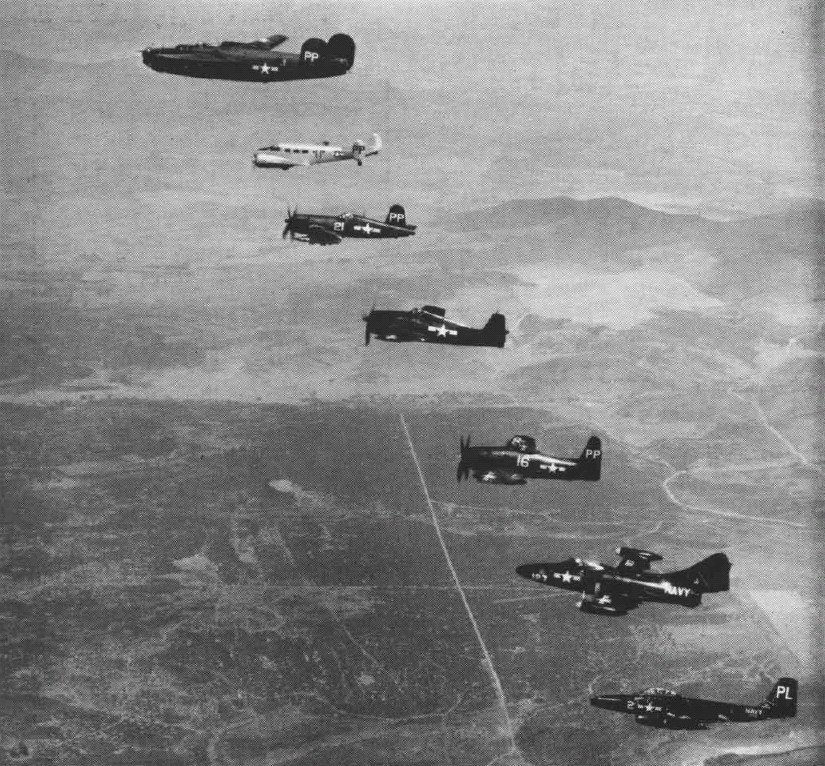
Service. The first F9F-2s went to the Blue Angels on 20 August 1949 and to VMF-115 and VF-11 that autumn; the museum's 123050 was the 65th aircraft, delivered 28 September 1949[7, 9]. In Korea from 1950 to 1953 it was the Navy's main jet. Argentina bought 28 F9F-2Bs in late 1957 — 24 to fly, four for spares — took delivery from August 1958, made its first jet carrier landing with one on 27 July 1963, and struck the type off on 9 June 1971 after grounding it in 1969[21, 1].
Variant
F9F-3 — the insurance policy that got there first
Engine: Allison J33-A-8, 4,600 lbf[5]. Built: 54, delivered between August 1948 and November 1949 in Bureau Numbers scattered through the first F9F-2 block[5, 1]. Because the Allison aircraft were ready first, the F9F-3 was the first Panther in squadron service: VF-51 at NAS San Diego received it on 8 May 1949, replacing FJ-1 Furies, and it was VF-51's F9F-3s that flew the Navy's first jet combat mission on 3 July 1950[7, 5].
The J33 proved the weaker engine, and "in October 1949 virtually all F9F-3s were re-engined" with the J42 — bringing them to F9F-2 standard, so that the type effectively vanished from the inventory (another source dates the conversions from February 1950)[5, 20]. Two F9F-3 airframes had second careers: BuNo 122562 carried the Emerson Aero X17A rolling nose turret at Patuxent River until the project was cancelled in early 1954, and BuNo 122560, re-engined, was still flying handling-qualities research at Langley when NACA became NASA on 1 October 1958[5, 22, 23]. No F9F-3 survives.



Variant
F9F-4 — the stretch, with the wrong engine
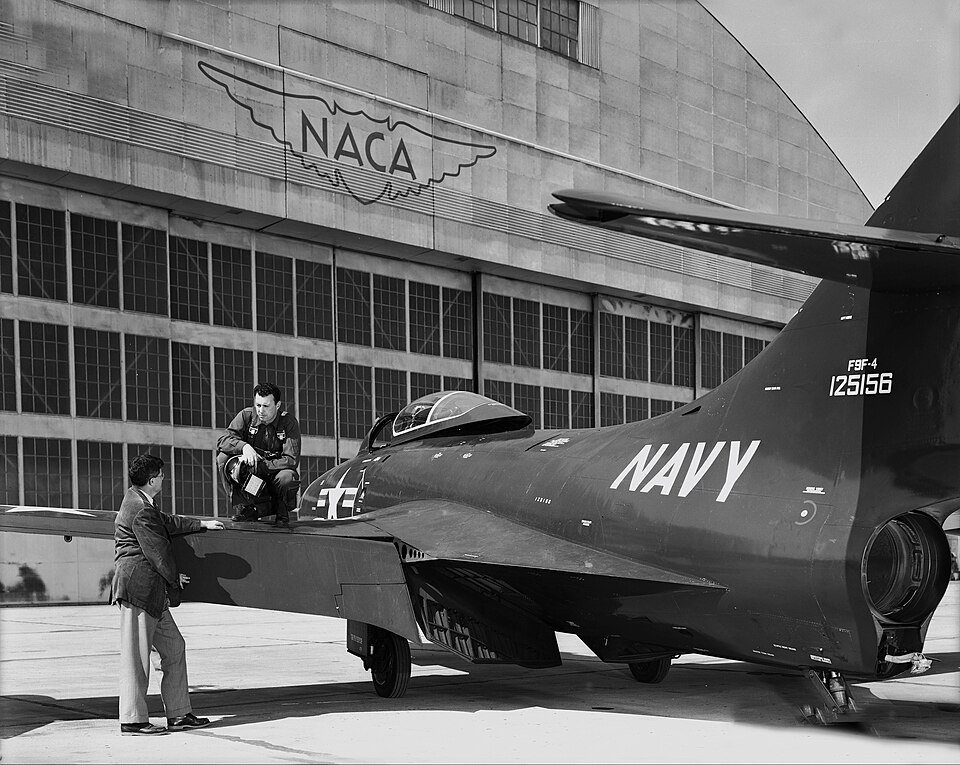
Engine: Allison J33-A-16 with water injection, 6,250 lbf dry and 6,950 lbf wet[6, 2]. Airframe: a forward fuselage 19.5 inches longer, internal fuel raised from 923 to 1,003 gallons, and a taller, larger vertical tail — the shape every later Panther kept[6]. Two F9F-2 airframes, 123084 and 123086, became XF9F-4s; 123084 first flew on 5 July 1950[6]. Built: 73 were ordered at first and 109 completed[2, 6, 20].
"The J33-A-16 turbojet proved to be unreliable in service, and many F9F-4s were delivered to the Navy as J48-powered F9F-5s, and most of the others were re-engined with J48-P-6As once they entered service"[6]. The Marines kept J33 aircraft — VMF-115 lists F9F-2s and F9F-4s in Korea and after, and the Minneapolis reserve's VMF-213 was flying F9F-4s in 1956 (see the home page). One F9F-4, BuNo 125081, was modified in early 1954 as the test bed for a boundary-layer-control system that blew engine bleed air over the flaps — the first successful use of the technique, worth 9 knots of stall speed on take-off and 7 on approach[6, 1]. Two F9F-4s survive, at Pima and in a Costa Mesa park.
Variant
F9F-5 and F9F-5P — the definitive Panther
Engine: Pratt & Whitney J48 — a licence-built Rolls-Royce RB.44 Tay — in -P-2, -P-4 and -P-6A versions, 6,250 lbf dry and 7,000 lbf with water injection, in the stretched F9F-4 airframe[10, 2, 1]. The first F9F-5 prototype flew on 21 December 1949[2]. Built: 616, "not counting F9F-4 conversions", making it the most numerous Panther; one summary's 725 is simply 616 plus the 109 F9F-4s[2, 14, 1]. Deliveries ran from October 1951 to August 1952[20]. It was the Panther of the Korean War's last year, of the Blue Angels from October 1951, and of the last fleet squadrons in 1956[23].
F9F-5P. Thirty-six unarmed photo-reconnaissance aircraft were built new, with vertical and oblique cameras in a nose 14.6 inches longer still, for an overall length of 40 feet[2]. They flew with VC-61 and VC-62 detachments off Korea; one confirmed block is 126265–126290[8]. F9F-5K and F9F-5KD. Target drones and drone directors converted from F9F-5s; by the September 1962 Tri-Service redesignation "the only Panthers left in service were the F9F-5KD drone directors", which became DF-9E, and the last of those was struck off in the mid-1960s[7, 13]. Planes of Fame's 126277 is the one drone-programme survivor.
Front-line Navy fighter squadrons gave the Panther up in 1956; training units and the Naval and Marine Air Reserve flew it until 1958 — which is where the F9F-5 that served at NAS Minneapolis in 1958–59 comes in[1, 7].





Arithmetic
How many Panthers, and what they were called after 1962
| Item | Count | Basis |
|---|---|---|
| XF9F-2 prototypes (122475, 122477) | 2 | [3] |
| XF9F-3 prototype (122476) | 1 | [3] |
| Development airframes 123084–123086 (two XF9F-4s and 123085) | 3 | [6]; 123085's identity not found |
| F9F-2 | 564 | BuNo blocks[4] |
| F9F-3 | 54 | BuNo blocks[5] |
| F9F-4 | 109 | BuNo blocks[6] |
| F9F-5 | 616 | [2, 1] |
| F9F-5P | 36 | [2, 1] |
| All airframes | 1,385 | 2 + 1 + 3 + 564 + 54 + 109 + 616 + 36 — matches Wikipedia and USWarplanes[1, 14] |
| Without the three G-79 prototypes | 1,382 | the "usual" figure: 567 + 54 + 109 + 616 + 36 |
| Production Bureau Numbers only | 1,379 | 564 + 54 + 109 + 616 + 36 |
| AirVectors' total | 1,328 | leaves out the 54 F9F-3s, treating them as F9F-2s[2] |
The 1962 names
The Tri-Service system of September 1962 gave the Panther family the letters F-9: on paper F9F-3 → F-9B, F9F-4 → F-9C, F9F-5 → F-9D, F9F-5P → RF-9D, F9F-5K → QF-9D and F9F-5KD → DF-9E[1]. In practice only the last was ever painted on an aircraft, because by 1962 the drone directors were the only Panthers still in service[7]. (No 1962 designation was assigned to the F9F-2; none was left.) The Cougars took F-9F through TF-9J — F9F-6 → F-9F, F9F-7 → F-9H, F9F-8 → F-9J, F9F-8B → AF-9J, F9F-8P → RF-9J and the two-seat F9F-8T → TF-9J[2, 15, 14].
Why the Cougar kept "F9F". Design 93 "retained the fuselage, vertical tail, engine, and undercarriage of the F9F-5"; the first three were F9F-5s "modified on the production line"[17, 2]. Under the Navy's pre-1962 system a modification of an existing type took the next dash number rather than a new designation — so the swept-wing aircraft became the F9F-6 and got a new popular name instead. That reading of the rule is this page's; no source states the Navy's reasoning in so many words.
Everything else in the family — F9F-2B, -2P, -2D, -2KD, -5K, -5KD — was a conversion and adds nothing to the total.
The missing link
From Panther to Cougar: sweeping the wing
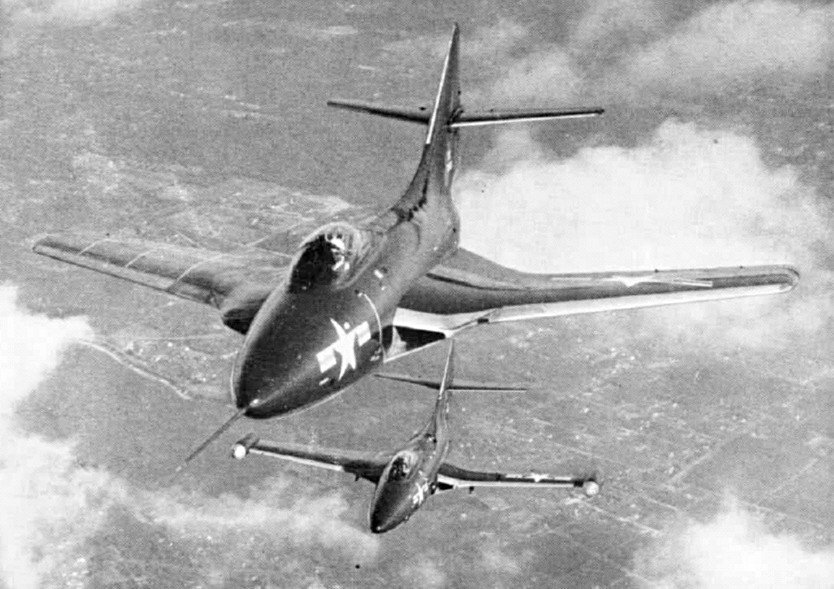
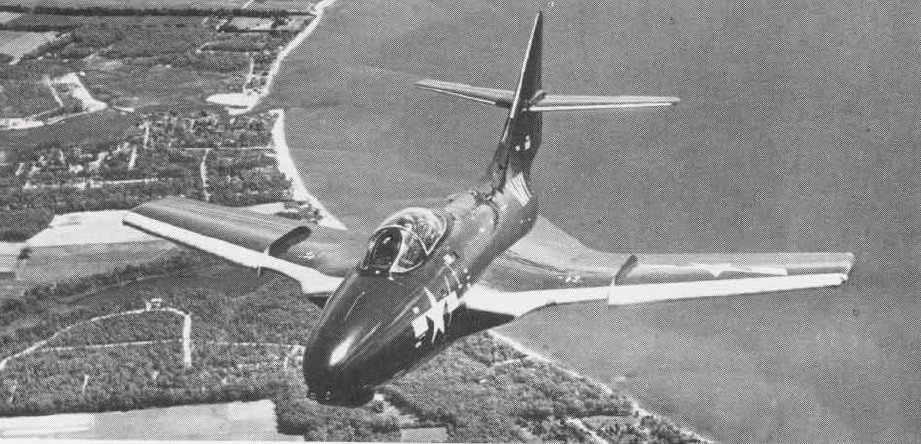
The MiG-15 appeared over Korea in November 1950 and the Navy had no swept-wing fighter to answer it; "development of a swept-wing Panther became more urgent"[16]. Grumman proposed Design 93 (G-93) — a Panther with wings and tailplane swept 35° — and the Navy signed the contract on 2 March 1951[16, 2]. Three F9F-5s were taken off the line as prototypes, Bureau Numbers 126670–126672 (one a static-test airframe), and 126670 flew on 20 September 1951 with Grumman test pilot Fred C. Rowley, six months after the contract[8, 15, 2]. It is now at the Smithsonian's Udvar-Hazy Center[16].
What changed. Wing and tail swept 35°; the Panther's leading-edge flaps replaced by slats, with larger split flaps; upper-wing "flaperette" spoilers taking over roll control; an all-flying horizontal tail that "cured the reversibility problem" of ailerons and elevators at high speed; the tip tanks gone, replaced by fuel in the thicker wing; a lengthened fuselage, extended intakes and big wing-root fillets — and the J48-P-6A, later the 7,250-lbf J48-P-8[17, 16, 15, 2]. The Panther's centre fuselage stayed almost unchanged to keep the centre of gravity where it was[15].
What it bought. The critical Mach number rose "from 0.79 to 0.86 at sea level and to 0.895 at 35,000 feet", and top speed from 575 mph for the Panther to 654 mph for the F9F-6 — about 80 mph for the same engine[16, 15, 9].
Why sweep works, in plain words
As an aeroplane nears the speed of sound, the air rushing over the curved top of the wing reaches Mach 1 before the aeroplane does and forms a shock wave; drag leaps and the controls go strange. The speed at which that begins is the wing's critical Mach. On a swept wing the air meets the leading edge at a slant, and only the part of the flow running straight across the wing, front to back, does the lifting and makes the shock. At 35° that part is about 82 per cent of the aeroplane's speed (the cosine of 35°). The swept wing therefore "feels" a slower airflow than the aeroplane is flying, and the shock arrives later — which is exactly what NASM's 0.79-to-0.86 figures show. The price is paid at the other end of the speed range: the same slanted flow gives less lift at low speed and pushes the tips toward stalling first, and ordinary ailerons lose authority or reverse at high speed. That is why Grumman needed slats and bigger flaps for the carrier approach, spoilers for roll and a flying tail for pitch — the fixes are sourced; the explanation is general aerodynamics[17, 16].




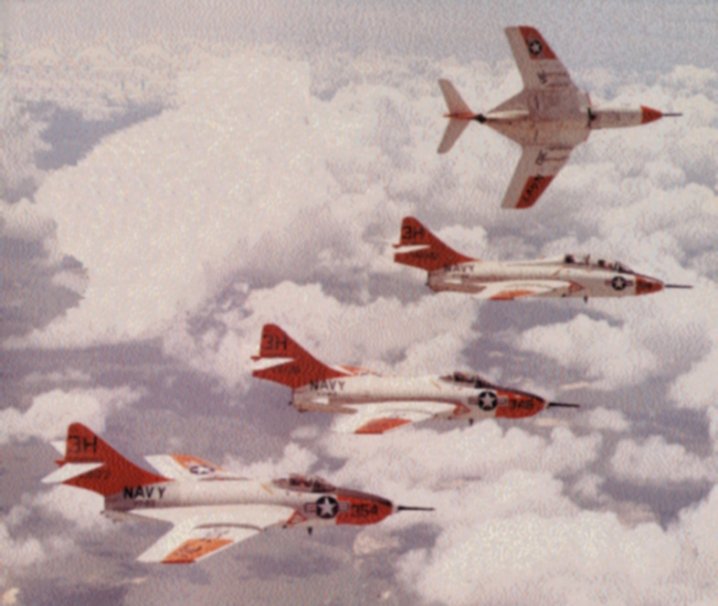

Production
The Cougar line
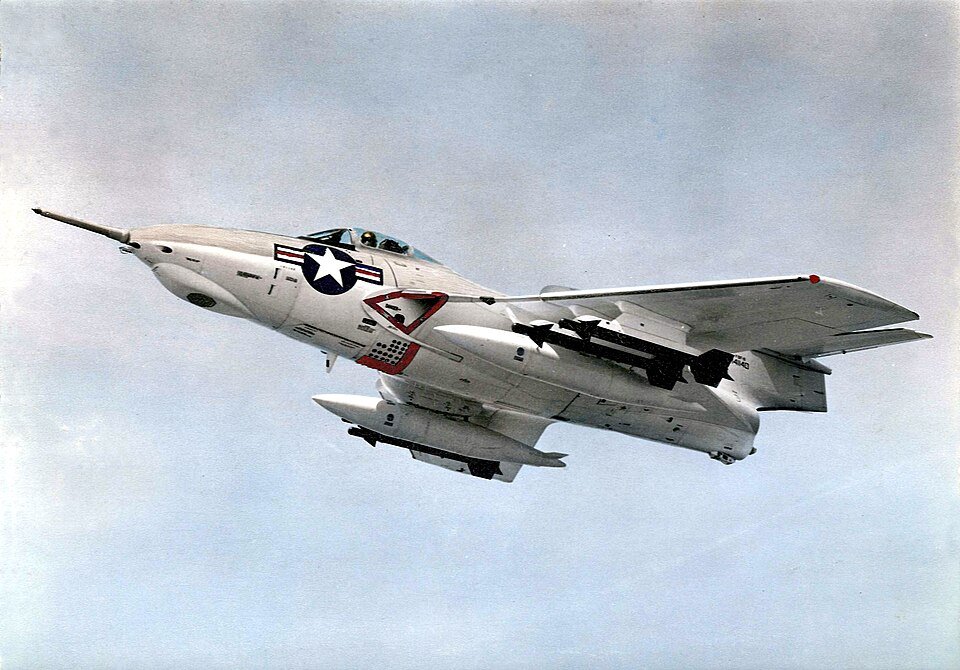
F9F-6: 646, deliveries late 1952 to 2 July 1954; VF-32 the first squadron in December 1952 — too late for Korea. F9F-6P: 60 photo aircraft. F9F-7: 168 with the Allison J33-A-16A, most re-engined with the J48. F9F-8: 601 built 1954–57 with an 8-inch stretch, a redesigned wing, an in-flight refuelling probe and Sidewinders; F9F-8B nuclear-strike conversions; F9F-8P: 110 with a "duck's bill" camera nose. F9F-8T: the two-seat trainer, first flown 4 April 1956 — 399 by most counts, 377 "acquired" by the museum's. Total about 1,984, or 1,988 with prototypes[2, 16, 15, 18, 14].
Service
Blue Angels, Vietnam, Argentina
The Blue Angels flew F9F-6s for the 1953 season, gave them back to the fleet, then flew F9F-8s from 1954 until the F11F Tiger in 1957[19, 15]. The only Cougars in combat were TF-9J trainers used by the Marines as "Fast FAC" airborne controllers in Vietnam — four-aircraft detachments with H&MS-11 at Da Nang and H&MS-13 at Chu Lai from 1966 to 1968[19, 15, 18]. Argentina, the Panther's only export customer, took two F9F-8Ts in 1962, the first aircraft to fly supersonic in that country, and retired them in 1971[15, 2].
Open questions
What this page could not settle
The identity of BuNo 123085 (possibly the F9F-5 prototype). The full F9F-5 Bureau Number blocks (only 126627–126669 confirmed). The number of F9F-2P conversions. Which utility squadrons flew the DF-9E drone directors. The role of the Taylor Turbine Corporation, sometimes named as the first American Nene licensee before Pratt & Whitney. And the names of Grumman's Panther designers.